Locust-Kass trigger should be signaled both before and after sampling #246

Description

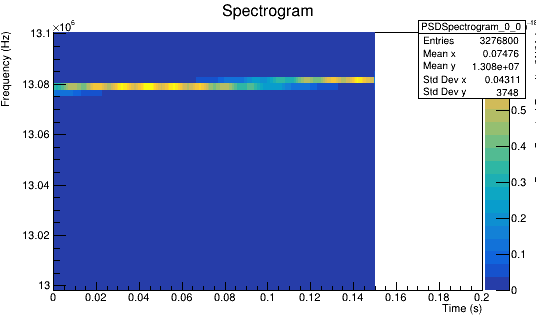
At slow Locust sampling frequencies (20 MHz) and large trajectory step sizes (1.135 orbits) it is possible for Kassiopeia steps to be missed. If the cyclotron frequency is calculated from the raw Kassiopeia current as in the cavity simulation, this can lead to phase errors . The observable problem appears as frequency kHz jitter in post processing. This will likely need to be addressed with a confirmation Mutex (after sampling) in addition to the existing trigger Mutex (before sampling). In the meantime, there are two known ways to avoid the frequency jitter:
- Run with smaller (0.135 orbits) Kassiopeia step sizes, as in the second plot below.
- Run with Locust-Kass feedback enabled, which slows down Kassiopeia and prevents skipped steps.
Step size = 1.135 orbits:
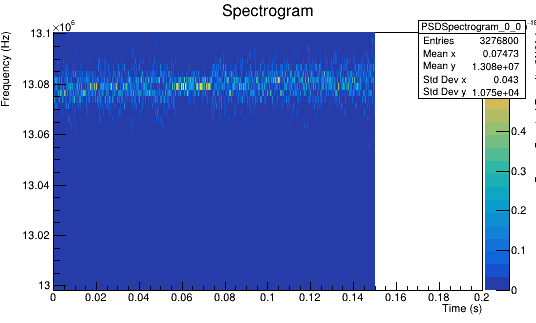
Step size = 0.135 orbits: