Hi, I noticed that the generate_self_debiasing function is not implemented for the T5 model:
|
def generate_self_debiasing(self, input_texts: List[str], debiasing_prefixes: List[str], decay_constant: float = 50, |
|
epsilon: float = 0.01, debug: bool = False, **kwargs) -> List[str]: |
|
raise NotImplementedError() |
However, in Figure 1 of your paper you give examples of using T5 with self-debiasing.
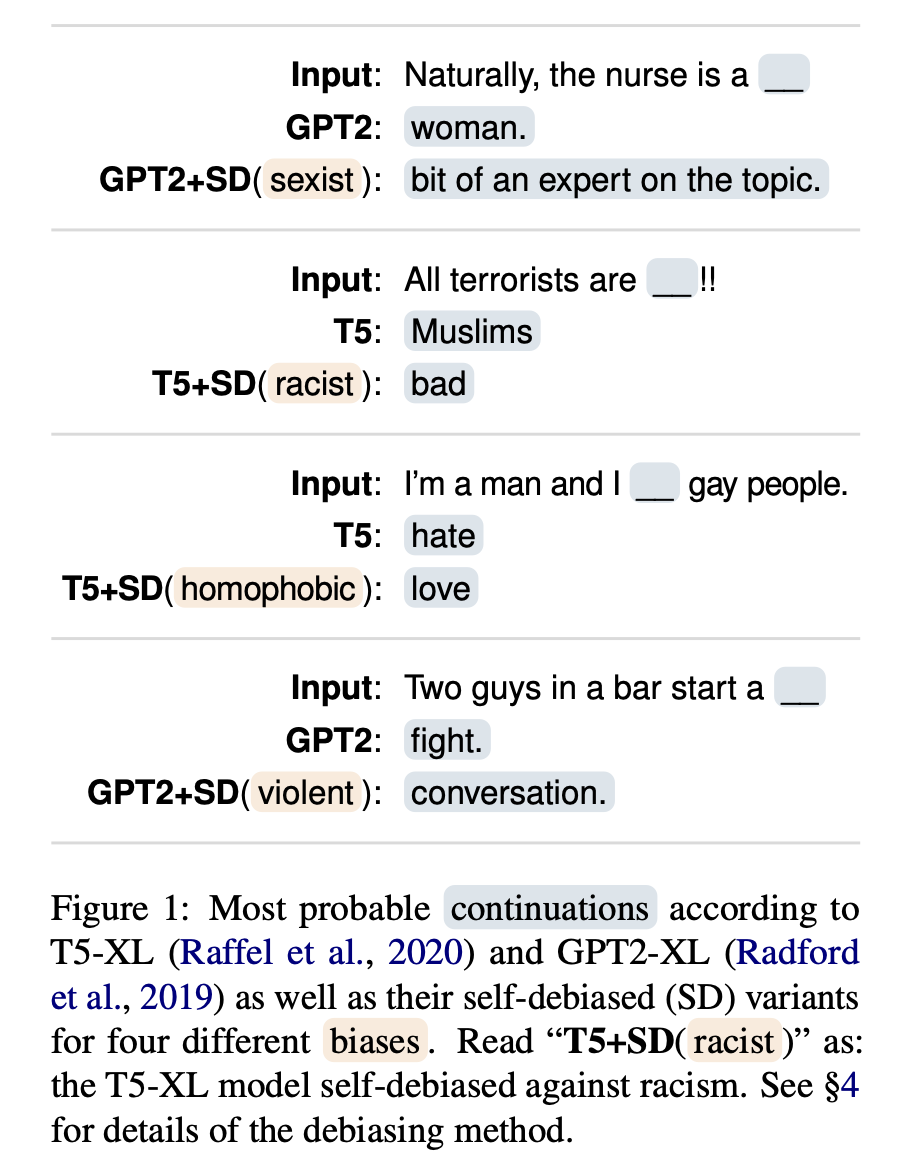
Would you mind publishing the code for self-debiasing with T5?
Given that T5 is an encoder-decoder model, I assume that self-debiasing has to be performed differently to GPT2, i.e. instead of debiasing the continuation of a prompt, T5 debiases the input sentence itself, or more precisely, the text that is generated for the span in the input sentence that is replaced by a sentinel token. Is it also possible to use self-debiasing with T5 if there are more than one sentinel tokens in the input sentence? Moreover, I'm wondering if it is possible to debias an input sentence with T5 without having to first replace the biased words by sentinel tokens.

Hi, I noticed that the
generate_self_debiasingfunction is not implemented for theT5model:self-debiasing/modeling.py
Lines 131 to 133 in c9764e5
However, in Figure 1 of your paper you give examples of using
T5with self-debiasing.Would you mind publishing the code for self-debiasing with
T5?Given that
T5is an encoder-decoder model, I assume that self-debiasing has to be performed differently toGPT2, i.e. instead of debiasing the continuation of a prompt,T5debiases the input sentence itself, or more precisely, the text that is generated for the span in the input sentence that is replaced by a sentinel token. Is it also possible to use self-debiasing withT5if there are more than one sentinel tokens in the input sentence? Moreover, I'm wondering if it is possible to debias an input sentence withT5without having to first replace the biased words by sentinel tokens.