


KitAMR.jl is a distributed adaptive Cartesian grid solver for kinetic equations, developed based on P4est.jl. Its goal is to achieve large-scale parallel solving of 2D and 3D flows across all regimes, leveraging GPUs, differentiable programming, and machine learning to enhance solving efficiency.
For 1.0 version, we enable the solver to determinately simulate rarefied flows with high efficiency. The following functionalities have been implemented:
- Physical mesh generation for arbitrary boundary geometry;
- Immersed boundary method for Maxwellian gas-surface interaction model;
- Geometric adaptation of physical space grids;
- Dynamic adaptation of physical space grids;
- Dynamic adaptation of velocity space grids;
- Distributed parallelism on CPUs;
- Load balancing based on phase space grid density;
- Linear reconstruction with second-order spatial accuracy;
- Composite Newton-Cotes rule with second-order quadrature accuracy;
- VTK&JLD output for post-processing.
All of the funcationalities are applicable to both 2D and 3D cases.
In kinetic theory, methods simulate the macroscopic motion of fluids by describing the evolution of distribution functions of fluid particles in velocity space over time. Such methods include direct simulation Monte Carlo (DSMC), discrete velocity method (DVM), lattice Boltzmann equation (LBE), gas-kinetic scheme, semi-Lagrangian method, implicit-explicit (IMEX) method, and others.
In kinetic methods, the state of the fluid is described by a distribution function
, where
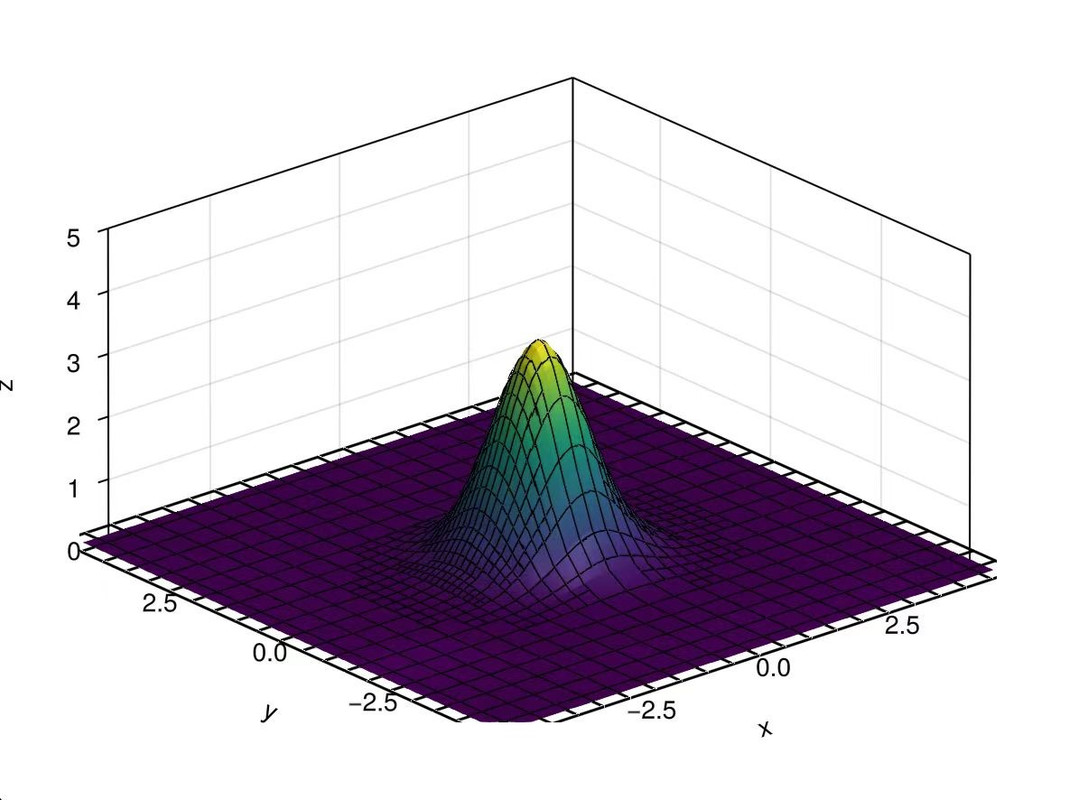](https://postimg.cc/ygSWRH14 "distribution function in 2-D velocity space")
The evolution of the distribution function follows the Boltzmann equation.
The Boltzmann equation holds a central position in kinetic theory, which is an integro-differential equation, with a four-fold integral term on the right-hand side. The complexity introduced by this term makes solving the Boltzmann equation challenging. Therefore, as a simplification, kinetic methods often solve its model equations instead.
The simplified equation obtained after simplifying the collision term is known as the Shakhov model equation:
, Where
The underlying discretization of the Boltzmann equation is based on finite volume method, with its discrete form as follows:
, where
Currently the best supported numerical flux is the semi-implicit DVM, with interface variables obtained from linear reconsitruction with the VanLeer limiter. For specific implementation details, please refer to the relevant literature.
DVM is one of the popular approaches for solving rarefied flow problems. In this method, the particle velocity space is discretized into a finite set of points and the numerical quadrature rule is utilized to approximate the integration of moments. Since the particle velocity space is discretized into a finite set of points, the continuum Boltzmann equation is reduced to the corresponding discrete velocity Boltzmann equation (DVBE). Based on the original DVM, great variety of algorithms have been developed, including unified gas-kinetic scheme (UGKS), discrete unified gas-kinetic scheme (DUGKS), semi-Lagrangian method, etc. Most of the above methods can be applied from free molecular regime to continuum regime. But in order to make the quadrature error to be small enough, a large number of discrete velocity points are usually required. In particular, for fluid flows near continuum regime, the computational cost of DVM is much larger than those traditional CFD methods based on the Navier-Stokes equation.
Considering the above limitation of DVM, we adopt Adaptive Mesh Refinement (AMR) to improve solving efficiency. AMR reallocates computational resources based on flow features, balancing efficiency and accuracy.

Hypersonic rarefied flow over a cylinder. The simultaneous AMR in physical space (left) and velocity space (right) are performed.
The current solver discretizes with tree-based Cartesian grids, adapting the mesh in both physical and velocity space simultaneously, according to characteristics like conserved variables' gradients and the mass and energy proportion at the velocity collocations. Users can also customize the criteria for grid refinement or coarsening according to their own needs.
For an AMR solver, the load-balance ability is crucial for high efficiency. KitAMR.jl inherits the load-balance functionality in p4est. The domain decomposition is performed in physical space. The physical grids are encoded into a 1-dimensional sequence by Morton code, and are partitioned to maintain the phase grids number on each processor approximately equal.

The variation of the processor rank in physical domain during a simulation.
Cartesian grids offer advantages such as high grid quality, automated mesh generation, nature of the parallelism and capability for dynamic adaptation, but struggle with complex boundary geometries. To address this challenge, we developed an Immersed Boundary Method (IBM) for the discrete velocity model of the Boltzmann equation, which has been planted in KitAMR.jl. For more details, you may refer to our paper: https://doi.org/10.48550/arXiv.2512.20252.

