Your agent remembers facts (if you installed hrr-memory). Now let it notice when beliefs change.
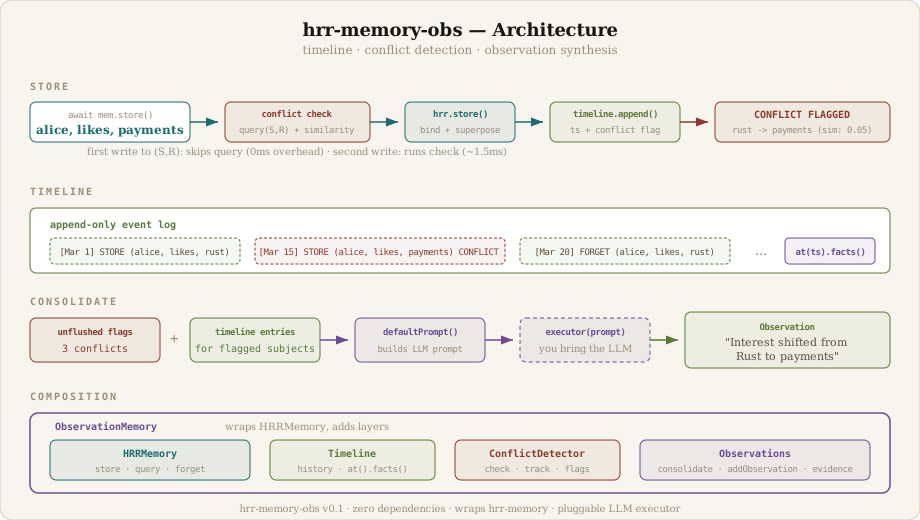
hrr-memory-obs wraps hrr-memory with temporal awareness, algebraic conflict detection, and LLM-driven observation synthesis. When your agent stores (alice, likes, payments) after previously storing (alice, likes, rust), the library flags the conflict automatically. Consolidate the flags into natural-language observations whenever you want — with whatever LLM you want.
npm install hrr-memory-obs hrr-memoryimport { HRRMemory } from 'hrr-memory';
import { ObservationMemory } from 'hrr-memory-obs';
const hrr = new HRRMemory();
const mem = new ObservationMemory(hrr);
await mem.store('alice', 'interested_in', 'rust');
await mem.store('alice', 'interested_in', 'payments');
mem.flags();
// → [{ subject: 'alice', oldObject: 'rust', newObject: 'payments', similarity: 0.05 }]
mem.history('alice');
// → [{ ts: ..., op: 'store', object: 'rust' },
// { ts: ..., op: 'store', object: 'payments', conflict: { oldObject: 'rust' } }]
mem.at(Date.now()).facts('alice', 'interested_in');
// → ['rust', 'payments']On every store(), the library checks if the (subject, relation) pair already has a value in HRR. If it does, it compares the old and new object vectors using cosine similarity. Low similarity = belief change = flag.
The first write to any (subject, relation) pair skips the check entirely — zero overhead. The query only runs on subsequent writes, exactly when conflicts are possible.
Flags accumulate until you consolidate them. The library builds the prompt; you bring the LLM.
const mem = new ObservationMemory(hrr, {
  executor: (prompt) => callYourLLM(prompt),
});

// ... after some conflicting stores ...

const observations = await mem.consolidate();
// → [{ subject: 'alice', observation: 'Interest shifted from Rust to payments',
//       evidence: [...], confidence: 'high' }]
Or skip the LLM entirely and write observations directly:
mem.addObservation({
  subject: 'alice',
  observation: 'Interest shifted from Rust to payments',
  evidence: [{ ts: 1711234567890, triple: ['alice', 'interested_in', 'rust'] }],
  confidence: 'high',
});mem.at(lastWeek).facts('alice', 'interested_in');
// → ['rust'] (what we knew then)
mem.at(Date.now()).facts('alice', 'interested_in');
// → ['rust', 'payments'] (what we know now)This is a symbolic replay of the timeline, not an HRR rebuild. Fast and cheap.
Two files: the HRR index (backward compatible) and the observations/timeline.
mem.save('hrr-index.json', 'observations.json');

const loaded = ObservationMemory.load('hrr-index.json', 'observations.json', {
  executor: (prompt) => callYourLLM(prompt),
});The built-in defaultPrompt instructs the LLM to produce structured JSON with evidence chains. Override it:
import { ObservationMemory, defaultPrompt } from 'hrr-memory-obs';

const mem = new ObservationMemory(hrr, {
  executor,
  promptFn: (input) => myCustomPrompt(input),
});| Method | Returns | Description |
|---|---|---|
await store(s, r, o) |
Promise<boolean> |
Store triple, record timeline, check conflicts |
await forget(s, r, o) |
Promise<boolean> |
Forget triple, record timeline |
query(s, r) |
QueryResult |
Delegated to HRRMemory |
querySubject(s) |
Fact[] |
Delegated to HRRMemory |
search(r?, o?) |
Triple[] |
Delegated to HRRMemory |
ask(question) |
AskResult |
Delegated to HRRMemory |
stats() |
Stats |
Delegated to HRRMemory |
history(s, r?) |
TimelineEntry[] |
Temporal history, oldest first |
at(ts).facts(s, r?) |
string[] |
Point-in-time symbolic query |
flags() |
ConflictFlag[] |
Unflushed conflict flags |
observations(s?) |
Observation[] |
Synthesized beliefs, newest first |
await consolidate() |
Observation[] |
LLM-driven synthesis of flagged changes |
addObservation(obs) |
Observation |
Store observation directly (no LLM) |
clearFlags(subject) |
void |
Clear flags for a subject |
save(hrrPath, obsPath) |
void |
Persist to two files |
load(hrrPath, obsPath, opts) |
ObservationMemory |
Load from two files (static) |
Each layer works independently:
import { Timeline, ConflictDetector, defaultPrompt } from 'hrr-memory-obs';

// Just the timeline
const tl = new Timeline();
tl.append({ ts: Date.now(), subject: 'x', relation: 'y', object: 'z', op: 'store' });

// Just the conflict detector
const cd = new ConflictDetector(hrr, 0.3);
cd.track('x', 'y');
cd.check('x', 'y', 'new_value');

// Just the prompt
const prompt = defaultPrompt({ entries, flags, existingObservations });| Operation | 1K entries | 10K entries |
|---|---|---|
store() (first write) |
~1.6ms | ~1.6ms |
store() (conflict check) |
~2.4ms | ~2.4ms |
history() |
0.1ms | 1.2ms |
at().facts() |
0.25ms | 2.9ms |
Zero overhead on first writes. Conflict detection adds ~0.8ms (one HRR query).
- openclaw-hrr-memory — OpenClaw plugin with diff-based MEMORY.md indexing, automatic timeline recording, and conflict detection. Install with
openclaw plugins install openclaw-hrr-memory
MIT