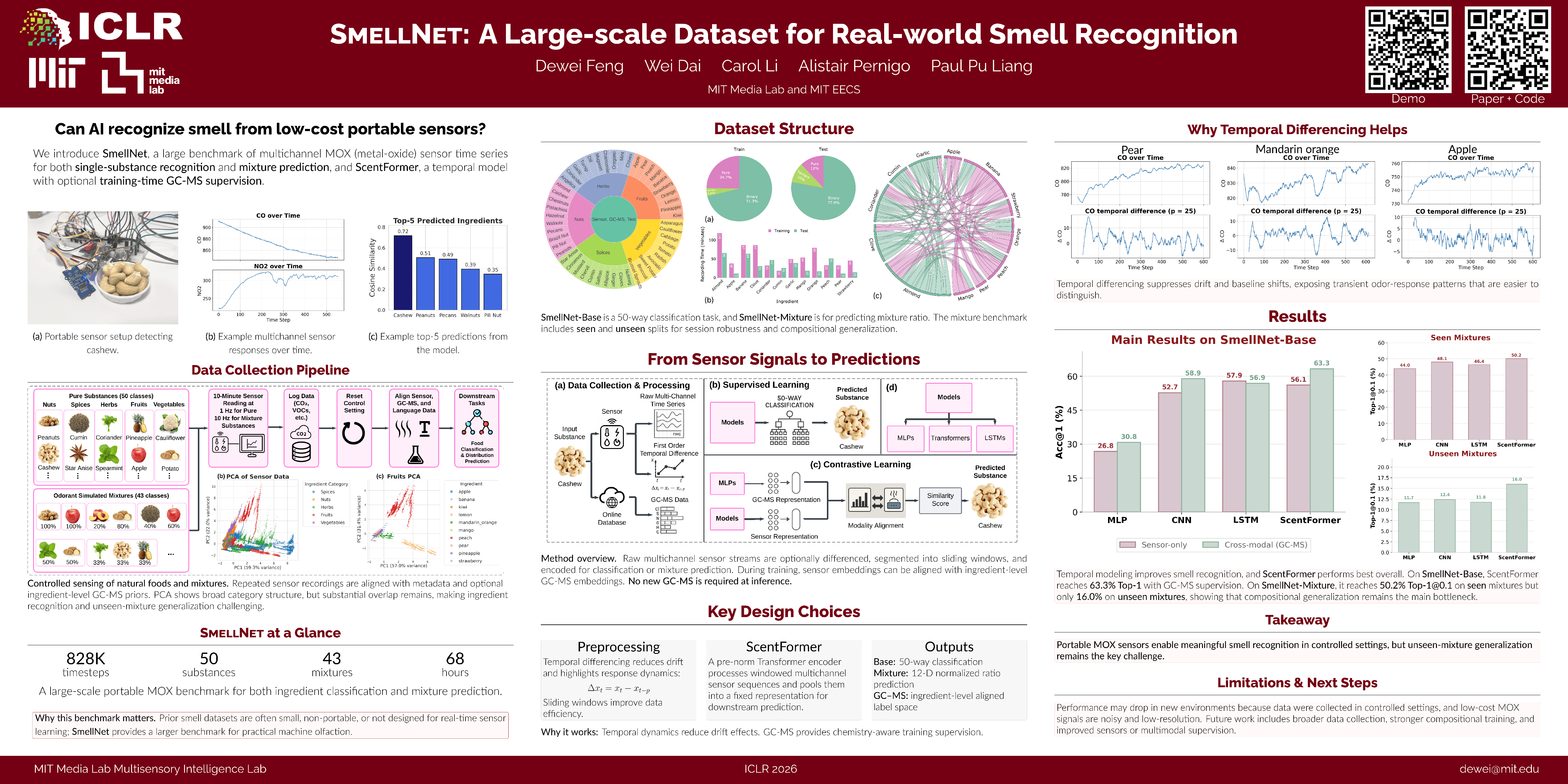
Overview of the smell sensing and modeling pipeline: hardware setup, multichannel sensor responses, and example model predictions.
Paper • Dataset • Poster • Code • Demo
SmellNet is a benchmark for sensor-based machine olfaction built from portable low-cost MOX gas sensors. It supports both single-substance recognition and mixture prediction, and introduces ScentFormer, a temporal model for learning from multichannel smell sensor time series with optional training-time GC-MS supervision.
- 828K sensor timesteps
- 50 base substances across nuts, spices, herbs, fruits, and vegetables
- 43 controlled mixtures
- 68 hours of recordings
- Benchmark tasks for both classification and mixture-ratio prediction
- Optional sensor-chemistry alignment using ingredient-level GC-MS representations
ScentFormer achieves:
- 63.3% Top-1 accuracy on SmellNet-Base with GC-MS supervision
- 50.2% Top-1@0.1 on seen mixtures
- 16.0% Top-1@0.1 on unseen mixtures

Main benchmark results: SmellNet-Base and mixture tasks.
These results show that temporal modeling is effective for smell recognition, while generalization to unseen mixtures remains a core challenge.
This repository contains:
- code for training and evaluating smell-recognition models
- preprocessing and analysis utilities for sensor data
- GC-MS processing pipelines for cross-modal supervision
- Arduino and data-collection utilities used in the sensing setup
- scripts for reproducing main experiments and regenerating figures
Large files (sensor recordings, gcms_processed/, etc.) are not stored in Git. Download them from the SmellNet dataset on Hugging Face and place them in the paths described in Quick Start so scripts can find them locally.
A 50-way classification benchmark for recognizing single substances from multichannel sensor time series.
A benchmark for predicting normalized mixture ratios over 12 base odorants, including:
- seen mixtures: known combinations under new recording sessions
- unseen mixtures: novel combinations for compositional generalization
The overall pipeline is:
- collect multichannel sensor responses from portable MOX sensors
- optionally apply temporal differencing to emphasize signal dynamics
- segment the signal into sliding windows
- train temporal models such as CNNs, LSTMs, and ScentFormer
- optionally align sensor embeddings with ingredient-level GC-MS embeddings during training

git clone https://github.com/MIT-MI/SmellNet.git
cd SmellNetpip install -r requirements.txtThis installs dependencies for training, analysis, and optional tools (serial capture, t-SNE/UMAP, Plotly). If you only need a minimal stack, you can install the core packages by hand (torch, pandas, numpy, scikit-learn, matplotlib). For a particular CUDA version of PyTorch, install torch from pytorch.org first, then run pip install -r requirements.txt (pip will keep your existing torch if it satisfies the constraint).
Download the released files from Hugging Face — DeweiFeng/smell-net and unpack them into this clone. The dataset card lists archives and filenames.
cd models
python run.py \
  --train-dir ../base_data/training \
  --test-dir ../base_data/testing \
  --real-test-dir ../base_data/testing \
  --gcms-csv ../gcms_processed/gcms_food_vectors.csv \
  --models transformer \
  --epochs 90 \
  --batch-size 32 \
  --lr 0.001
For fuller sweeps, see:
scripts/run_experiment.bashscripts/run_experiments.sh
Use:
models/run_mixture.py
and the commented mixture template in:
scripts/run_experiment.bash
models/           training and evaluation code
scripts/          experiment wrappers and figure-generation utilities
analysis/         notebooks and analysis scripts
base_data/        SmellNet-Base sensor CSVs (training/testing; not in git — download from Hugging Face)
gcms_processed/   GC-MS vectors (not in git; download from Hugging Face)
gcms_analysis/    scripts to build GC-MS embeddings (outputs go to gcms_processed/)
data_collection/  acquisition helpers and sensor-side tooling
data_stats/       summary plots and tables
figures/paper/    regenerated paper figures
preprocessing/    raw-to-structured data utilities
Arduino/          firmware and sensor libraries
SmellNet can support research and prototyping in:
- machine olfaction
- food and beverage monitoring
- allergen-relevant sensing
- multimodal sensing
- environmental and industrial monitoring
- digital olfaction and human-AI interaction
If you use SmellNet in your work, please cite:
@inproceedings{feng2026smellnet,
  title={SmellNet: A Large-Scale Dataset for Real-World Smell Recognition},
  author={Feng, Dewei and Dai, Wei and Li, Carol and Pernigo, Alistair and Liang, Paul Pu},
  booktitle={International Conference on Learning Representations (ICLR)},
  year={2026}
}For questions or collaboration, please contact Dewei Feng at dewei@mit.edu.