Tips for the Reader
- How to Type Hebrew
Vocabularyis marked as shown here.-
🧠: Memory devices, called Mnemonics, are marked as shown here. They appear below things to memorize.
Hebrew was originally written with just consonants. Some consonants change appearance when written as the final consonant of a word. These are called sofit. Several sounds are repeated. The dagesh (dot) indicates plosive sounds. Every 'ch' is guttural as in Bach. Hebrew is read right to left.
| Consonant | Sofit | Name | Sound |
|---|---|---|---|
| א | Alef | silent | |
| בּ | Bet | b | |
| ב | Vet | v | |
| ג | Gimel | g | |
| ד | Dalet | d | |
| ה | He | h | |
| ו | Vav | v | |
| ז | Zayin | z | |
| ח | Chet | ch | |
| ט | Tet | t | |
| י | Yod | y | |
| כּ | Kaf | k | |
| כ | ך | Chaf | ch |
| ל | Lamed | l | |
| מ | ם | Mem | m |
| נ | ן | Nun | n |
| ס | Samek | s | |
| ע | Ayin | silent | |
| פּ | Pe | p | |
| פ | ף | Fe | f |
| צ | ץ | Tsade | ts |
| ק | Qof | q | |
| ר | Resh | r | |
| שׁ | Shin | sh | |
| ש | Sin | s | |
| ת | Tav | t |
🧠: Several characters are easily confused. Memorizing the distinctions helps.
Distinction Vet ב Kaf כ Vet is two strokes, which creates a tittle in the bottom right. Dalet ד Resh ר Dalet is two strokes, which creates a tittle in the top right. Vav ו Zayin ז Zayin comes across the line. Gimel ג Nun נ Gimel has a foot. Tet ט Mem מ Tet has an open top. Ayin ע Tsade צ Ayin is written like a 'y'; Tsade like an 's'. Sin ש Shin שׁ Sin puts us on the left hand of God, like the dot. He ה Chet ח Tav ת He has a gap, Chet fills it out, Tav has a foot. Mem Sofit ם Samek ס Samek is rounded.
Vowels were pointed underneath the consonants after the fact by the Masoretes. The circles represent any consonant. Qamets and Qamets Hatuf are visually identical; however, Qamets Hatuf is rare. It is presumed that anciently long and short vowels were pronounced differently. This audible distinction can be ignored today, but knowing long and short vowels will be important for future grammar.
| Short (Name) |
Long (Name) |
Sound | Transliteration |
|---|---|---|---|
◌ַPatah |
◌ָQamets |
ah | a |
◌ֶSegol |
◌ֵTsere |
eh | e |
◌ִHiriq |
י◌ִHiriq Yod |
ee | i |
◌ָQamets Hatuf |
◌ֹ / וֹHolem (Vav) |
oh | o |
◌ֻQibbuts |
וּShureq Vav |
oo | u |
🧠: The dominant vowel within every name, except the rare Qamets Hatuf, is the sound that vowel makes (e.g., pAtah, tsEre, hirIq, hOlem, qibbUts).
🧠: All the consonant vowels are long.
🧠: The Qamets Hatuf occurs most commonly in the word for all, כֹּל (Deut 6:5).
The shva is another Msorete pointing. It can be silent to divide syllables, or pronounced. It is NOT pronounced when immediately proceded by a short vowel.

Nouns and adjectives agree in gender and number. Various endings express this agreement, including a set of common (agreeing for male and female) endings to represent two things. These dual agreements are commmonly used for things like body parts, of which there are two.
Nouns can be chained together using construct endings. The chain always ends with one absolute noun, and constructs a single idea. The final construction, or construct chain, indicates possession. The final, absolute noun, is used to determine if the entire phrase is indefinite or definite (uses a/an or the).
This following image demonstrate the difference between the construct and absolute forms of four masculine plural word examples. Stand-alone absolute forms are shown in the right column. Construct forms are demostrated on the left beginning each phrase.
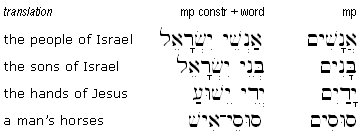



Focus on the last example. The maqqeph (dash) has no pronounciation and simply connects related words. Notice how horse (סוס) changes from iym (abs., masc., pl.) to eh (cons., masc., pl.). Also note that translations can use apostrophe "s" or "of" without misrepresenting the Hebrew.
| Masculine | Feminine | |||
|---|---|---|---|---|
| Absolute | Construct | Absolute | Construct | |
| Singular | ◌ ◌ ◌ | ◌ ◌ ◌ | ה◌ָ ◌ ◌ah |
ת◌ַ ◌ ◌at |
| Plural | ים◌ִ ◌ ◌iym |
י◌ֵ ◌ ◌eh |
וֹת ◌ ◌ ◌ot |
וֹת ◌ ◌ ◌ot |
| Dual | יִם◌ַ ◌ ◌ayim |
י◌ֵ ◌ ◌eh |
🧠: The feminine singular sound is 'ah', which is common to romance languages.
🧠: In Hebrew, ה often changes to ת.
🧠: The masculine plural sound is 'iym' as in Elohim, which you may find familiar. It can literally translate to gods, but is often used as a plural of majesty.
🧠: The dual sound is 'ah' + 'iym' or 'ayim', and could be thought of as combining fem. and masc. into a complete couple.
All verbs in Hebrew have a root (or lexical entry) comprised of three consonants. The primary task of Biblical Hebrew is determining which three consonants constitute the lexical entry and looking up that entry in the lexicon. Verb conjugations in Hebrew express person, gender, number, and aspect. These conjugations must be parsed to identify the lexical entry.
A verb's grammatical aspect inflects the degree to which the action is completed and, in Hebrew, can be perfect or imperfect. Generally speaking, imperfect is used for incomplete action and perfect for complete action.
Conjugations in Biblical Hebrew do not inflect tense. Either aspect can be used in any tense. There are many ways to employ aspect in language; the following are just some English examples to illustrate the difference between complete and incomplete action and shouldn't be taken prescriptively.
| Perfect | Imperfect | |
|---|---|---|
| Past | I killed | I was killing |
| Present | I have killed | I kill |
| Future | I will have killed | I will kill |
Some conjugations are common and only have one entry shown (e.g., the 1st person and 3rd person plural). Conjugations with multiple interpretations are color coordinated.
| Singular | Plural | |||
|---|---|---|---|---|
| Person | Masculine | Feminine | Masculine | Feminine |
| 3rd | ◌ ◌ ◌ he |
ה◌ָ ◌ ◌she |
וּ ◌ ◌ ◌ they |
|
| 2nd | תָ ◌ ◌ ◌ you |
תְ ◌ ◌ ◌ you |
תֶם ◌ ◌ ◌ y'all |
תֶן ◌ ◌ ◌ y'all |
| 1st | תִי ◌ ◌ ◌ I |
נוּ ◌ ◌ ◌ we |
| Singular | Plural | |||
|---|---|---|---|---|
| Person | Masculine | Feminine | Masculine | Feminine |
| 3rd | ◌ ◌ ◌ יhe |
◌ ◌ ◌ תshe 🟡 |
י ◌ ◌ ◌ וּthey |
ת ◌ ◌ ◌ נָהthey 🔴 |
| 2nd | ◌ ◌ ◌ תyou 🟡 |
ת ◌ ◌◌ִיyou |
ת ◌ ◌ ◌ וּy'all |
ת ◌ ◌ ◌ נָהy'all 🔴 |
| 1st | ◌ ◌ ◌ אI |
◌ ◌ ◌ נwe |
🧠: This is the procedure I follow, which gets me 78.9% of the way.
(I find memorizing the 10 facts listed here way easier than the 76 in the chart.)
Step # Parsing Trick 1) Aspect Imperfect aren't perfect, so they need a prefix. 2) Person ת is 2nd person (or Fem. 3rd). 3) Number וּ ,נ, and ◌ֶ are plural. 4) Gender Feminine are תְ / ◌ִי / נ or neat ( n/-iy/-t).To get this working 100% of the time, memorize these additional 6 facts, which override the procedure:
- The person (usually first person) of the 5
commonendings.- The gender of perfect 3rd person singular, which is identical to the absolute singular noun endings.
Parsing a verb begins by identifying the three consonants which comprise the lexical root. Some verbs will lose consonants as they are conjugated. This image illustrates where consonsants commonly drop off and what evidence they may leave behind.
Take תִּתֵּן as an example. We must decide which of the three belong to the lexical root. You may tempted to interpret it as pf. 3MS (perfect 3rd masculine singular). An astute parser will notice the first tav could be an imperfect prefix and pause. Ultimately, the tsere gives us evidence that a consonant may have jumped ship, in this case a yod. Thus, the correct parsing is ipf. 2ms (or 3fs depending on context).
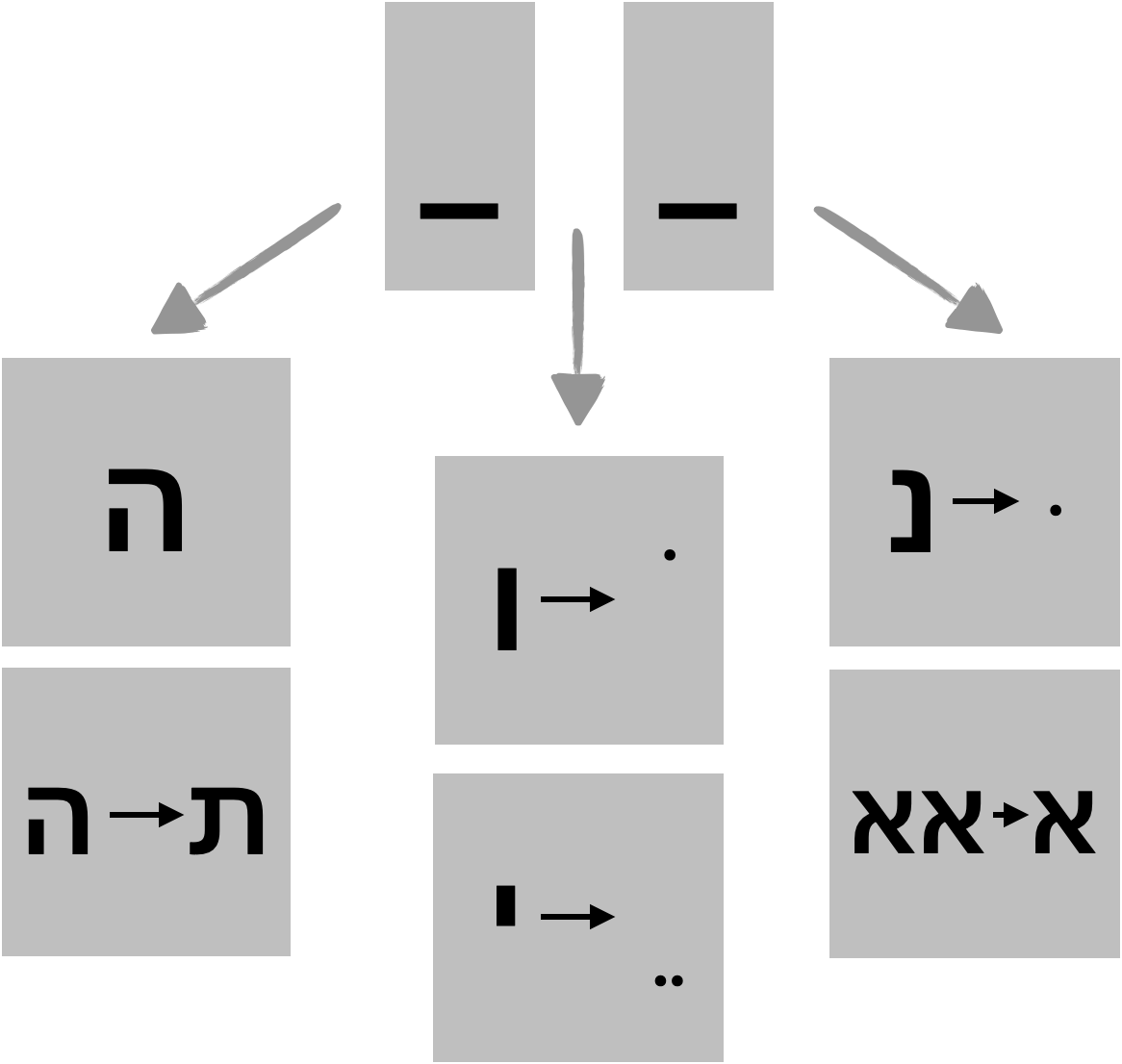
🧠: A student can, and may have already, appropriately associate י (yod) with the 'eh' sound and ו (vav) with the 'oh' sound. This is easily remembered by considering the similar mouth shape used to produce these consonant vowel pairs.
Once you've found the lexical entry or root, look it up in the lexicon. We use "A Concise Hebrew and Aramaic Lexicon of the Old Testament" by William L. Holladay. The following image illustrates where to find relevant information in the lexicon.

🧠: Practice parsing verbs with ParseTrainer.
Possessive pronoun when connected to noun. Otherwise objective pronoun.
| Masculine | Feminine | |||
|---|---|---|---|---|
| Person | Singular | Plural | Singular | Plural |
| 3rd | וֹ him/his |
them/their |
ה◌ָher |
ן them/theirNun/Hay(segol) |
| 2nd | תָ ◌ ◌ ◌ you |
תְ ◌ ◌ ◌ you |
תֶם ◌ ◌ ◌ y'all |
תֶן ◌ ◌ ◌ y'all |
| 1st | תִי ◌ ◌ ◌ I |
נוּ ◌ ◌ ◌ we |
???
| Active Voice | Passive Voice | Reflexive Voice | |
|---|---|---|---|
| Simple Action | Qal stem | Niphal stem | – |
| Causative Action | Hiphil stem | Hophal stem | – |
| Resultative Action | Piel stem | Pual stem | Hithpael stem |
???
Food that is fit or proper for Jewish people to eat.
- Not all animals are kosher. (Leviticus 11)
- Fish need fin and scales.
- Mammals must chew their cud and have split hooves, which makes their milk kosher also.
- Chicken, turkey, duck, and eggs are kosher.
- Kosher animals must be prepared in a special way.
- Meat and dairy must never be mixed.
All holidays start at sundown the night before.
Candle lighting. Candles can't be lit or extinguished (including matches) during the holiday, but pilot lights are allowed. Words of blessing are shared with variations for each holiday by each person lighting a candle. Candles are not lit on Hanukkah or Purim. Tradition holds that women light the candles, as they are reponsibile for nurturing and the symbolic light within the home. Matriarch does all the candles, but custom has every other woman or girl do one themselves.
Commemorates the day Moses came down from the mountain or the Day of Atonement.
Highlights:
- No work.
- Candle Lighting.
- A day of personal fasting, "ye shall afflict your souls" (Leviticus 16:31)
- Traditional suggestions include avoiding: food or drink
- lotions or creams
- washing or bathing
- conjugal relations
- and leather shoes.
Commemorates the anniversary of our miraculous Exodus from Egyptian slavery. Lasts 7 days in Israel and 8 in the diaspora. During the passover, Jews may not own or consume chametz, anything containing grain that has risen. Chametz is sold and donated to charity or burned.
- Seder
- Candle lighting
- 15 step feast, center around the Exodus story telling
Highlights:
- Drinking four cups of grape juice
- dipping veggies into saltwater for appetizer
- children ask the four questions
- eating matzah (Cracker like food, to remember how our ancestors left Egypt without time to all bread to rise)
- eating bitter herbs,
- singing late into the night
Means "weeks", derived from Leviticus 23:15. Celebrated 7 weeks from passover to commemorate recieving the 10 commandments.
- Candle lighting for candle-lit dinner.
- No work.
- Eat Dairy Foods. Because it was Shabbat that day, they couldn't kill slaughter animals so they ate dairy.
- Cheese Blintzes
- Quiche
- Cheesecake
- Ice Cream
- Staying up late to learn Torah.
- Read 10 Commandments.