This package allows building and solving image segmentation problems such as Markov Random Fields (MRF) and Sparse Layered Graphs (SLG) using s-t graph cuts. The package itself is written purely in Python and contains logic for building graphs for both single- and multi-label problems. To solve the optimization problem it relies on a min-cut/max-flow algorithm (see Solvers).
Install default package using pip install slgbuilder or clone the repository. See Dependencies for more.
The package is primarily targeted multi-label/multi-object image segmentation problems. Common uses include:
- Surface detection
- Constrained multi-surface detection
- Object segmentation
- Interacting multi-object segmentation
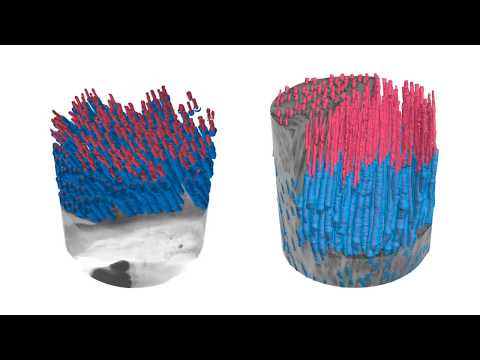
- Example code and notebooks
- Experimental notebooks (advanced 2D and 3D segmentation) [CVPR2020]
- Experimental notebooks (advanced 3D segmentation with parallel QPBO) [ICCV 2021]
The package support both the common grid-graph structure, as used by Delong and Boykov and the ordered multi-column structure, popularized by Li et al.. Although representing image data in the grid structure may seem like the obvious choice, there are several advantages (e.g. smaller graph and "better" constraints) when using the ordered multi-column structure for segmentation if possible. However, doing so requires resample the data, which usually requires knowledge about the location of each object in the image.
The package currently supports eight different solvers. In simple cases the default BK Maxflow and QPBO solvers should do fine. For submodular problems, all solver should give find a globally optimal solution. Only the QPBO solvers support nonsubmodular problems, and for such problems a complete solution cannot be guaranteed. For large or time-critical tasks it may be favorable to use a non-default solver, e.g., HPF or PQPBO. We are currently working on a comparative study of min-cut/max-flow algorithms, which should provide better insights into which algorithms perform the best on different computer vision tasks. If you're interested, check out this repository.
For submodular problems (e.g. segmentation without exclusion constraints), the default solver, used by the MaxflowBuilder is an updated version the Boykov-Kolmogorov Maxflow algorithm, accessed through the thinmaxflow package. MaxflowBuilder is synonymous with BKBuilder.
For nonsubmodular problems (e.g. segmentation with exclusion constraints) the solver used by the QPBOBuilder is this version of the QPBO algorithm, accessed through the thinqpbo package.
The HPFBuilder is an alternative to the standard MaxflowBuilder. It relies on the HPF algorithm, which is often superior in performance compared to BK Maxflow. HPFBuilder depends on the thinhpf package. It supports int32 and float32 capacities/energies, however, int32 is recommended.
An alternative to the BK Maxflow solver is the Google Maxflow implementation, which is a push-relabel algorithm. This can be done using the ORBuilder class. Apart from performance, the difference between the Google and BK Maxflow algorithms is that the Google implementation doesn't support floating type capacities. If MaxflowBuilder is slow when solving, try using the ORBuilder instead.
A slightly optimized modern reimplementation of the BK Maxflow algorithm is available using the MBKBuilder. Depends on the shrdr package. Using this builder should reduce memory usage and increase performance slightly compared to the MaxflowBuilder/BKBuilder.
A parallel version of the MBK implementation found in the shrdr package. Can significantly reduce solve for large problems on multicore systems. Jupyter notebooks with examples using the similar PQPBOBuilder can be found in the supplementary material of this article.
A slightly optimized modern reimplementation of the QPBO algorithm is available using the QPBOBuilder. Depends on the shrdr package. Using this builder should reduce memory usage and increase performance slightly compared to the QPBOBuilder.
A parallel version of the MQPBO implementation found in the shrdr package. Can significantly reduce solve for large problems on multicore systems. Jupyter notebooks with examples of use can be found in the supplementary material of this article.
To solve the s-t graph-cut optimization problems the package relies on one of the following packages:
thinmaxflow(installed by default) - Package for computing min-cut/max-flow of an s-t graph using the Boykov-Kolmogorov (BK) Maxflow algorithm.thinqpbo(installed by default) - Package for solving submodular and nonsubmodular optimization problems using the Quadratic Pseudo-Boolean Optimization (QPBO) algorithm implementation by Kolmogorov. Solver based on the BK Maxflow.thinhpf- Package for computing min-cut/max-flow of an s-t graph using the Hochbaum Pseudoflow (HPF) algorithm.ortools- Package for computing min-cut/max-flow of an s-t graph using the Google OR Tools min-cut/max-flow implementation.shrdr- Package for computing min-cut/max-flow of an s-t graph optimized serial or parallel implementations of BK Maxflow and QPBO algorithms by Jensen and Jeppesen.
See links for further details and references.
Install with HPF solver.
pip install slgbuilder[thinhpf]
Install with Google OR Tools solver.
pip install slgbuilder[ortools]
Install with all extras.
pip install slgbuilder[all]
The shrdr package is not yet available on PyPI. Get it here!
- shrdr Python package (ICCV 2021)
- thinqpbo Python package
- thinmaxflow Python package
- thinhpf Python package
- C++ implementations of min-cut/max-flow algorithms
Contributions are welcome, just create an issue or a PR.
MIT License (see LICENSE file).
If you use this any of this for academic work, please consider citing our work:
N. Jeppesen, A. N. Christensen, V. A. Dahl and A. B. Dahl, "Sparse Layered Graphs for Multi-Object Segmentation," 2020 IEEE/CVF Conference on Computer Vision and Pattern Recognition (CVPR), 2020, pp. 12774-12782, doi: 10.1109/CVPR42600.2020.01279.
[ paper ] [ supp ] [ CVF ] [ IEEE ]
N. Jeppesen, P. M. Jensen, A. N. Christensen, A. B. Dahl and V. A. Dahl, "Faster Multi-Object Segmentation using Parallel Quadratic Pseudo-Boolean Optimization," 2021 IEEE/CVF International Conference on Computer Vision (ICCV), 2021, pp. 6240-6249, doi: 10.1109/ICCV48922.2021.00620.
[ paper ] [ supp ] [ CVF ] [ IEEE ]
@INPROCEEDINGS{9156301,  author={Jeppesen, Niels and Christensen, Anders N. and Dahl, Vedrana A. and Dahl, Anders B.},  booktitle={2020 IEEE/CVF Conference on Computer Vision and Pattern Recognition (CVPR)},   title={Sparse Layered Graphs for Multi-Object Segmentation},   year={2020},  volume={},  number={},  pages={12774-12782},  doi={10.1109/CVPR42600.2020.01279}}

@INPROCEEDINGS{9710633,  author={Jeppesen, Niels and Jensen, Patrick M. and Christensen, Anders N. and Dahl, Anders B. and Dahl, Vedrana A.},  booktitle={2021 IEEE/CVF International Conference on Computer Vision (ICCV)},   title={Faster Multi-Object Segmentation using Parallel Quadratic Pseudo-Boolean Optimization},   year={2021},  volume={},  number={},  pages={6240-6249},  doi={10.1109/ICCV48922.2021.00620}}