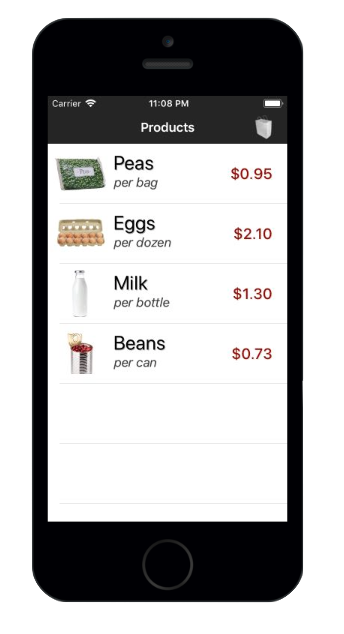
Pretty standard Apple MVC. We have 2 view controllers: ProductsViewController, the first one, lets the user select (or deselect) products; the second one is CheckoutViewController: manages quantities and the grand total. As requested in the assignment, the user can select a different currency in which prices are converted and shown accordingly.
I usually minimize the use of optionals and nils by unwrapping aggressively when I am in control of the optional at compile time1 (that is the same principle of IBOutlets) or when I can instantiate a dummy/default instance of a class, instead of spreading nils around2, for example:
let urlString = "http://apilayer.net/api/live?currencies=EUR,CHF,GBP"
let url = URL(string: urlString)!var layer = CALayer()
var path = UIBezierPath()I am a fan of IIFE in JavaScript. Since I also can do the same in Swift, I tend to isolate boring initialization details as in:
lazy var badgeLabel: UILabel = {
  let label = UILabel(frame: CGRect(x: 22, y: -2, width: 11, height: 11))
  label.backgroundColor = UIColor.red
  label.textColor = UIColor.white
  label.font = UIFont.boldSystemFont(ofSize: 7)
  label.textAlignment = .center
  label.text = "0"
  label.layer.cornerRadius = label.bounds.size.height / 2
  label.layer.masksToBounds = true
  label.layer.borderWidth = 1
  label.layer.borderColor = UIColor.white.cgColor
  label.isHidden = true
  return label
}()
I am a long-time rubyist. It shines through my Swift code:
let lineItems = range.reduce(emptyLineItem) { (acc, itemNumber) -> [LineItem] in
  let quantity = sample(Array(0 ... 9))
  let productName = "Product #\(itemNumber)"
  let productUnit = "Unit of Product #\(itemNumber)"
  let price = sample([1.43, 0.74, 2.13, 1.19, 3.42, 4.32])
  let productToAppend = Product(name: productName,
                                unit: productUnit,
                                priceInDollars: Decimal(price))
  let lineItemToAppend = LineItem(product: productToAppend,
                                  quantity: quantity)

  return acc + [lineItemToAppend]
}
Ruby is dynamic… but I also like statically typed languages with parametric polymorphism (the so called Generics):
import Foundation

func sample<T>(_ array: [T]) -> T {
  let randomNumber = Int(arc4random_uniform(UInt32(array.count)))
  return array[randomNumber]
}

func permutations<T>(_ xs: [T]) -> [[T]] {
  guard let (head, tail) = decompose(xs) else { return [[]] }
  return permutations(tail).flatMap { between(head, $0) }
}

func decompose<T>(_ array: [T]) -> (T, [T])? {
  guard let x = array.first else { return nil }
  return (x, Array(array[1..<array.count]))
}

func between<T>(_ x: T, _ ys: [T]) -> [[T]] {
  guard let (head, tail) = decompose(ys) else { return [[x]] }
  return [[x] + ys] + between(x, tail).map { [head] + $0 }
}I've produced two different test targets:
- ShopBagTests: scoring 25 Unit Tests (models, utils)
- ShopBagUITests: with 13 UI Tests (view controllers)
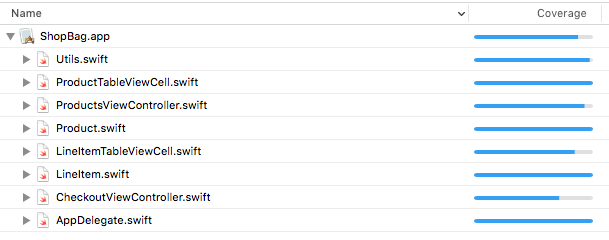
for a coverage of about 87.5% over less than 750 lines of code (ShopBag target). ShopBagTests and ShopBagUITests score respectively 446 and 497 LOC.
You can run the test suite from XCode issuing a ⌘U.
Thanks for your time!
Copyright 2017-2018 Michelangelo Altamore. It may be redistributed under the terms specified in the LICENSE file.