Implementation of algorithms for packet flow analysis (limited to TCP and UDP flows). Contains two variants of a program to compute the packet count:
- Exact count without dealing with space complexity
- Optimized implementation returning an approximate count (within a specific bound) using a probablistic algorithm/data structure (count-min sketch)
.
|-- data ... Contains packet dumps for offline analysis
|   |-- http.cap
|   |-- lbl.pcap
|   `-- mb.pcap
|
|-- helper ... Helper functions used during development
|
|-- plots ... Plots of frequency distributions of packet flows
|
|-- TaskOne ... Variant One (using a simple hash table to compute exact count)
|   |-- a.out
|   |-- HIST_FILE.txt ... Stores frequencies of unique flow tuples
|   |-- packet_analysis.cc
|   |-- packet_analysis.h
|   |-- plot_hist.py ... Generates frequency distribution plots from HIST_FILE
|   `-- profiling ... Valgrind massif memory profiling
|
`-- TaskTwo ... Variant Two (optimized using a count-min sketch, returns approximate count within bounds)
    |-- a.out
    |-- count_min_sketch.cc
    |-- count_min_sketch.h
    |-- FLOW_FILE.txt
    |-- packet_analysis.cc
    |-- packet_analysis.h
    `-- profiling ... Stores the unique flow tuples (generated from TaskOne)
Note: Significance of generated files is specified in the directory layout section
- Compile and run the TaskOne/packet_analysis.cc
g++ packet_analysis.cc -lpcap
./a.out [NAME OF DATA FILE]- This will generate HIST_FILE.txt and FLOW_FILE.txt (in the TaskTwo directory)
- Compile and run the TaskTwo/packet_analysis.cc
g++ packet_analysis.cc count_min_sketch.cc -lpcap
./a.out [NAME OF DATA FILE]- This will generate the count-min sketch (by analyzing packets from the input data file), and then estimate the frequency by reading in unique tuples from FLOW_FILE (generated in TaskOne to avoid having to manually enter flow tuples during the estimation phase).
- To profile the memory usage (heap) of the two variants using Valgrind
valgrind --tool=massif ./a.out [NAME OF DATA FILE]- This will generate a massif.out.pid file, which can be analyzed using ms_print
ms_print massif.out.pid file- To only display the graph of number of instructions VS memory usage
ms_print massif.out.pid | head -n 35The following are preliminary results when the two variants are tested using a sample packet dump file (LBL dataset)
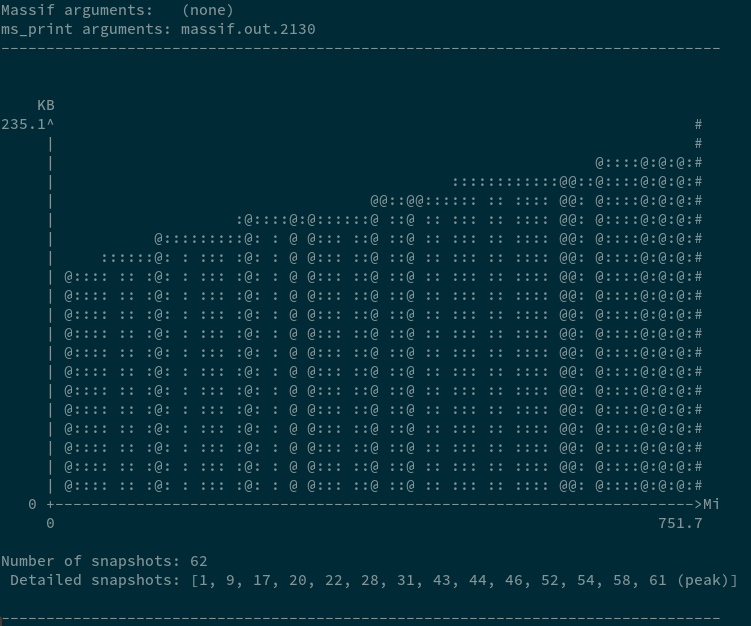
As evident, the hash map has a larger memory footprint (which increases during execution)
Sample of flow counts in the hash map (Pretty Printed)
Flow: (128.3.44.112,1582,148.184.171.6,445) Count: 1
Flow: (218.165.163.184,80,128.3.47.183,4353) Count: 3
Flow: (218.131.115.53,80,128.3.45.128,62337) Count: 5
Flow: (128.3.99.118,993,128.3.44.98,4591) Count: 123
Flow: (218.131.115.53,80,128.3.45.128,62336) Count: 5
Flow: (128.3.45.128,62336,218.131.115.53,80) Count: 5
Flow: (208.233.189.150,80,128.3.45.128,62335) Count: 5
Flow: (128.3.45.128,62335,208.233.189.150,80) Count: 5
Flow: (128.3.45.128,62334,208.233.189.150,80) Count: 5
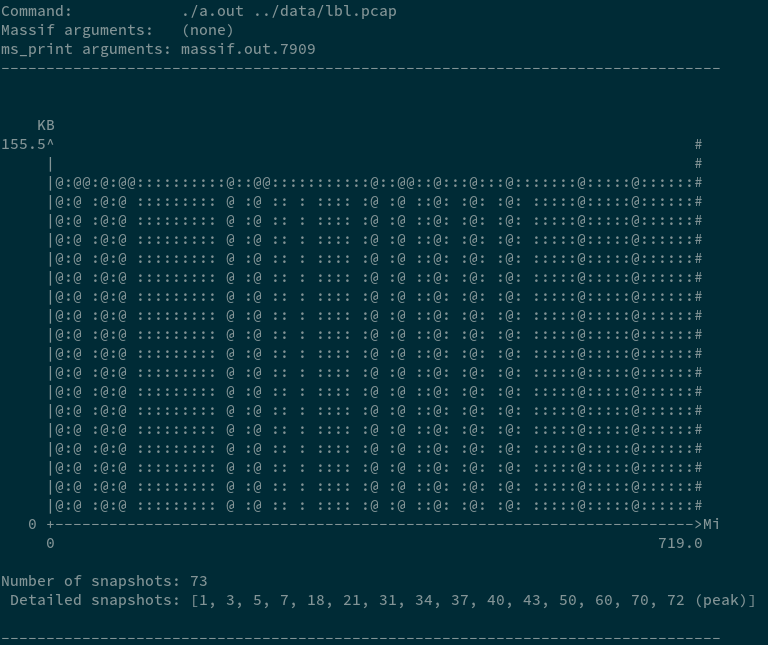
Whereas, the count-min sketch has a constant memory footprint (~150 kB). The difference should be increasingly evident for larger packet dumps with more unique flows.
Sample of flow counts in count-min sketch (Pretty Printed)
Flow: (128.3.44.112,1582,148.184.171.6,445) Estimate: 1
Flow: (218.165.163.184,80,128.3.47.183,4353) Estimate: 10
Flow: (218.131.115.53,80,128.3.45.128,62337) Estimate: 7
Flow: (128.3.99.118,993,128.3.44.98,4591) Estimate: 123
Flow: (218.131.115.53,80,128.3.45.128,62336) Estimate: 5
Flow: (128.3.45.128,62336,218.131.115.53,80) Estimate: 23
Flow: (208.233.189.150,80,128.3.45.128,62335) Estimate: 8
Flow: (128.3.45.128,62335,208.233.189.150,80) Estimate: 5
Flow: (128.3.45.128,62334,208.233.189.150,80) Estimate: 16
- Generate a frequency distribution plot for flow counts using HIST_FILE
python hist_plot.py- Depending on the degree of skewness, choose which algorithm to run (either CMS or similar algorithm such as Fast-AGMS). CMS has been observed to have better performance in skewed distributions, whereas Fast-AGMS is better for non-skewed distributions
- Generating frequency distribution for the sample datasets in the repository results in the following plots
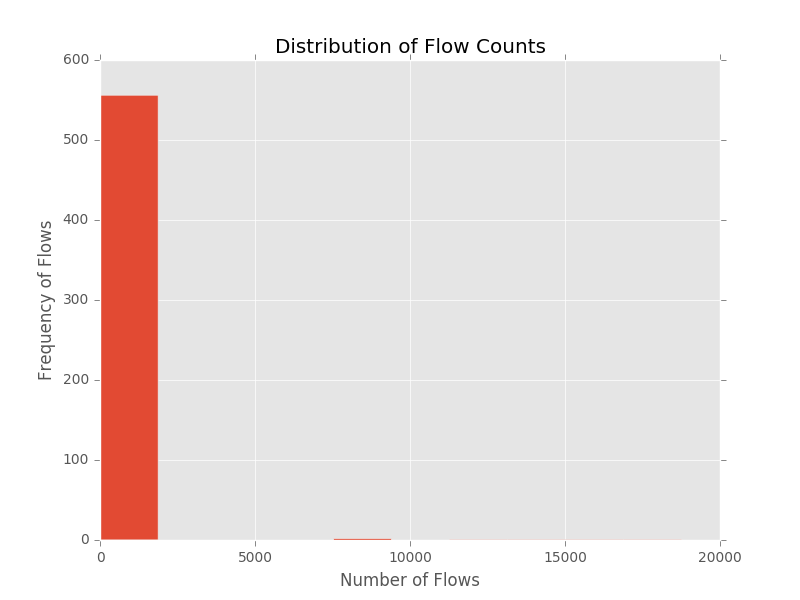
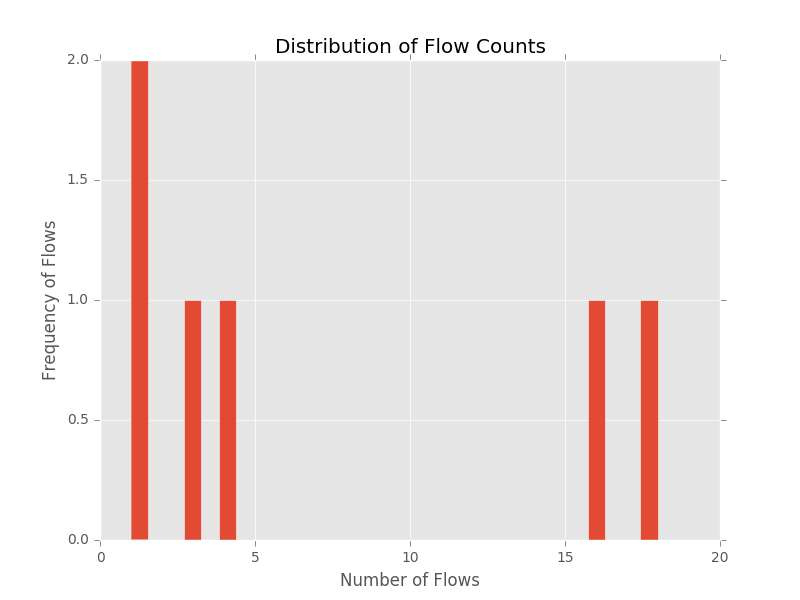
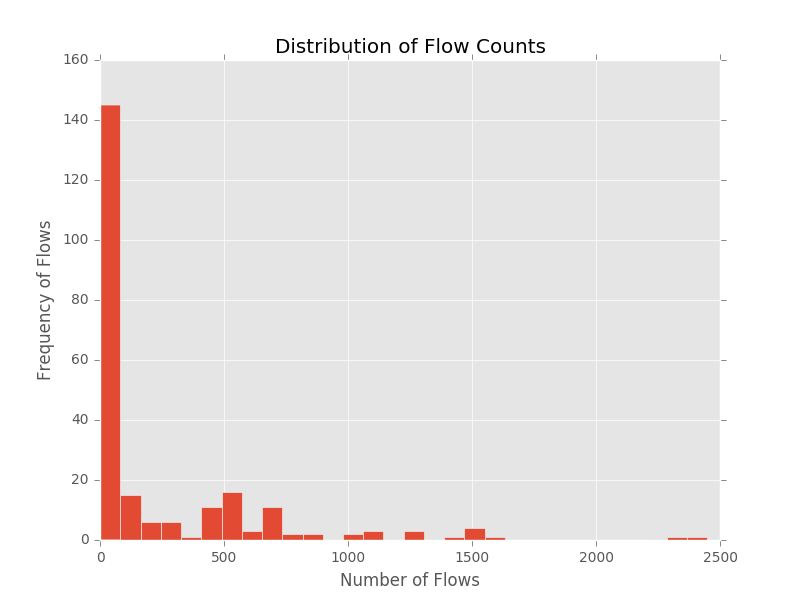
These preliminary plots suggest that CMS is well suited for these datasets.
Note: Need to find datasets with non-skewed flow frequency distributions, to test results.