


Convert any FastAPI app or OpenAPI spec into a CLI + SKILL.md for AI agents — in one command.
pip install fastapi-to-skill
fastapi-to-skill generate main:app -o ./skills/myapi/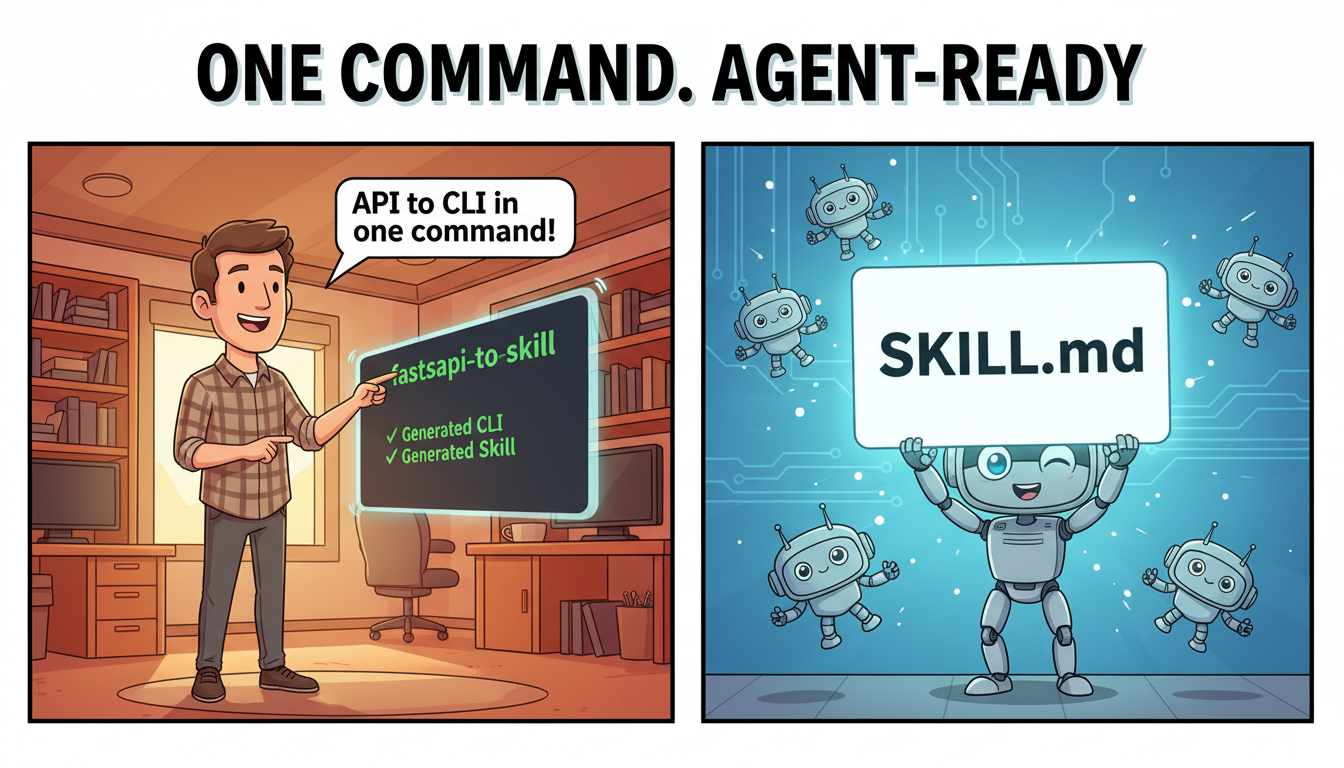
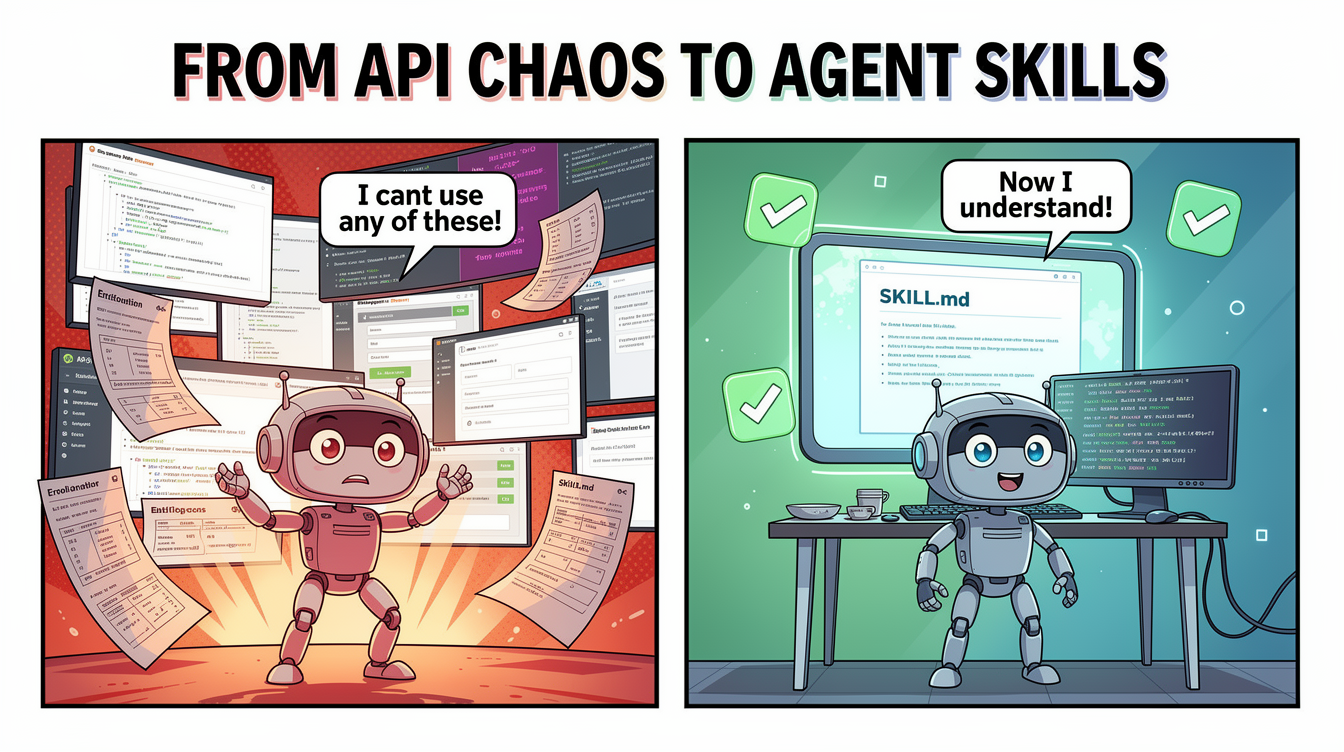
A year ago, APIs served frontends. Developers read docs, learned the UI, wrote integration code.
Now APIs serve AI agents. And agents don't read docs — they read skill files.
If your product has no SKILL.md, agents can't discover it, can't use it, and will use a competitor that does have one.
The new distribution channel is not the App Store. It's the agent skill registry.
fastapi-to-skill takes your existing FastAPI app (or any OpenAPI spec) and generates everything an AI agent needs to use your API:
| Output | What it is |
|---|---|
cli.py |
Standalone Typer CLI — one command per endpoint, no deps on this tool |
SKILL.md |
Universal skill file for Claude Code, OpenClaw, and any Agent Skills-compatible platform |
openapi.json |
Copy of the spec for reference |
pyproject.toml |
Install the CLI as a named command (pip install -e .) |
No MCP server. No AI costs. No infrastructure. Just files.
FastAPI auto-generates an OpenAPI spec from your Python type hints. You write:
@app.post("/tasks")
def create_task(task: Task) -> TaskOut:
    ...
FastAPI gives you a full API contract for free — endpoints, parameters, request bodies, types, auth schemes. Always in sync with your code. No manual YAML.
fastapi-to-skill reads that spec with one call to app.openapi() and turns it into agent-ready tools. The whole pipeline is: your type hints → OpenAPI spec → CLI + SKILL.md.
Big thanks to @sebastianramirez for building FastAPI + Typer — an ecosystem where this kind of tooling is possible in a weekend.
pip install fastapi-to-skill
# or for global CLI tools (recommended)
pipx install fastapi-to-skill# main.py
from fastapi import FastAPI
from pydantic import BaseModel
app = FastAPI(title="Task Manager API")
class Task(BaseModel):
title: str
done: bool = False
@app.post("/tasks")
def create_task(task: Task):
...
@app.get("/tasks/{task_id}")
def get_task(task_id: int):
...fastapi-to-skill generate main:app -o ./skills/task-manager/Output:
skills/task-manager/
├── cli.py          ← standalone CLI
├── SKILL.md        ← agent skill file
├── openapi.json    ← spec copy
└── pyproject.toml  ← install as named command
cd skills/task-manager/
pip install -e .

# Run without a command — shows SKILL.md (AI-friendly)
task-manager-api

# List all commands
task-manager-api --help

# See body schema for any command
task-manager-api create-task --help
# Body fields:
#   title: string (required)
#   done: boolean  default: False

# Call the API
task-manager-api create-task --body '{"title": "Ship the feature"}'
task-manager-api get-task 1
task-manager-api list-tasks --done false

# Search commands by keyword
task-manager-api search "task"fastapi-to-skill generate --spec openapi.json -o ./skills/myapi/
fastapi-to-skill generate --spec openapi.yaml -o ./skills/myapi/# Claude Code (default)
fastapi-to-skill generate main:app -t claude-code
# OpenClaw
fastapi-to-skill generate main:app -t openclaw# Preview without writing files
fastapi-to-skill generate main:app --dry-run
# Validate spec only
fastapi-to-skill generate main:app --validate
# Override base URL
fastapi-to-skill generate main:app --base-url https://api.myapp.comSet your credentials via environment variables before calling any command:
# API key
export MYAPI_API_KEY="sk-your-key"

# Bearer token
export MYAPI_TOKEN="your-token"

# Custom base URL
export MYAPI_BASE_URL="https://api.myapp.com"
The env var prefix is derived from your API title automatically.
When an AI agent encounters your CLI, it runs:
task-manager-api          # reads SKILL.md, understands the API
task-manager-api --help   # sees all available commands
task-manager-api create-task --help  # sees body schema
No human needed. The agent discovers capabilities, reads the contract, and starts calling commands.
The SKILL.md follows the Agent Skills open standard — compatible with Claude Code, OpenClaw, and any platform that supports it.
MIT