git-shadow transparently records coding activity between commits in near-real-time. Recorded activity is stored into per-commit git repositories that can be analyzed with existing git workflows.
TODO: put one of these gifs here: https://github.com/KeyboardFire/mkcast
Recording the coding process could potentially help answer a bunch of questions that I (and perhaps others) think are interesting about development:
- How does the coding process of someone who is an expert in a language or framework differ from that of someone who is just learning it?
- Can applying churn, ownership, and other fault prediction techniques to real-time coding data help programmers make fewer mistakes?
- Can the data that major internet services collect on us be used to help us understand why we make mistakes in code?
- Can emerging research in using quantified-self data to understand the coding process be applied in the real world?
- Do I actually write code in a different way than the rockstars (Knuth, Linus, et al.)? What about programmers I really admire? What are the differences in our techniques, and how can I get better?
Transparently logging live-coding activity could help answer these and similar questions. git-shadow is a simple tool that aims to perform this type of logging and enable developers to start analyzing coding data using tools and methods that have already been built around git.
Clone the git repo
$ git clone https://github.com/jfoote/git-shadow
Put git-shadow on your path
$ pushd git-shadow && ln -s `pwd`/git-shadow /usr/local/bin/git-shadow && popd
Configure vim to autoload vim-shadow
$ pushd git-shadow && ln -s `pwd`/vim-shadow ~/.vim/bundle
Change directories to a git repo
$ cd demo
Run git shadow activate
$ git shadow activate
Code with vim
$ vim main.c
Checkout an interesting commit (ex: where a bug was introduced)
$ git checkout 7dba55fb8590f043afe935a9b366814fa5727804
Run git analysis the shadow repository via git shadow <git command>, or access the repo directly at <repo>/.shadow/current
$ git shadow log -S 'goto fail'
Say a silly bug is found in my code during an internal code review, or worse...
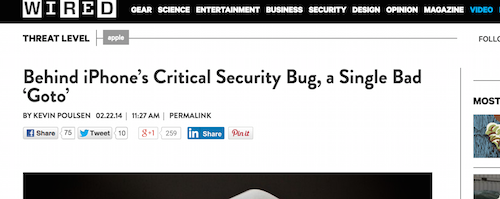
... and I decide to do some root-cause analysis with the help of git-shadow
Gratuitous Disclaimer: I had nothing to do with the real goto fail; bug, I've never worked for Apple, and I have no idea how the bug was actually introduced. IOW, it's just an example.
foote$ git log -S 'goto fail'
commit 7dba55fb8590f043afe935a9b366814fa5727804
Author: Jonathan Foote <jmfoote@loyola.edu>
Date:   Mon Jan 23 10:03:49 2014 -0500

    Fixed issue #PR59241

commit a4c55a248e8ad381d71466c0a8e3a477dfe5ac60
Author: Steve Jobs <steve@apple.com>
Date:   Fri June 11 14:00:55 2003 -0500

    Initial commit
I can see from the above pickaxe search that the only commits that added or removed a goto fail were the initial commit and commit 7dba55f... made by this shady Jonathan Foote character.
$ git checkout 7dba55fb8590f043afe935a9b366814fa5727804
Note: checking out '7dba55fb8590f043afe935a9b366814fa5727804'.
[...]

HEAD is now at 7dba55f... Fixed issue #PR59241
flan:demo user0$ git shadow log -S 'goto fail'
commit 69136d46fe975e9b239de44d330eaba3d4593665
Author: Jonathan Foote <jmfoote@loyola.edu>
Date:   Fri Jan 20 23:12:54 2014 -0500

    'file_modified'

commit 38013a4f169e3e8d4c8208d9cf65507559c95f29
Author: Jonathan Foote <jmfoote@loyola.edu>
Date:   Thu Jan 19 14:12:00 2014 -0500

    '7dba55fb8590f043afe935a9b366814fa5727804'
The oldest shadow commit discovered above, 38013a4... is the verbatim shadow copy of the code created when I first started working on the PR59241. According to pickaxe, the only other shadow commit to modify goto fail was 69136d4... made at Fri Jan 20 23:12:54 2014 -0500. Looks like I was coding late at night when I made the mistake...
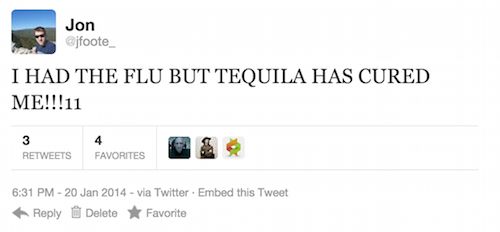
Oh. Yeah. Probably shouldn't have done any programming that Friday night.
Note: Drunk tweets notwithstanding, querying something like fluxtream could provide some novel insight.
I use git-shadow to continuously improve my programming skills, becoming to envy of all my friends. After a few years of flawless programming, I retire as a rich philantropist.
When git shadow activate is invoked, a mirror of all files that are tracked in the current repo is created in <repo path>/.shadow. Hooks are added to the current repo to keep the shadow consistent with HEAD.
All of the shadow logic is implemented in a single python script (git-shadow). The example editor plugin is implemented in two simple vimscript files (vim-shadow/autoload/shadow.vim and vim-shadow/plugin/shadow.vim).
As you code in vim, the vim-shadow plugin periodically passes the contents of the active buffer to the git-shadow shadow-file command, which adds them to a shadow git repository inside the .shadow directory.
Note that while this proof-of-concept uses vim, any editor that can be coerced into running git-shadow when buffer contents change could be used. Editors that support operational transformation like firepad.io and nitrous.io probably already have events in place that could be used to record near-real-time coding, for example.
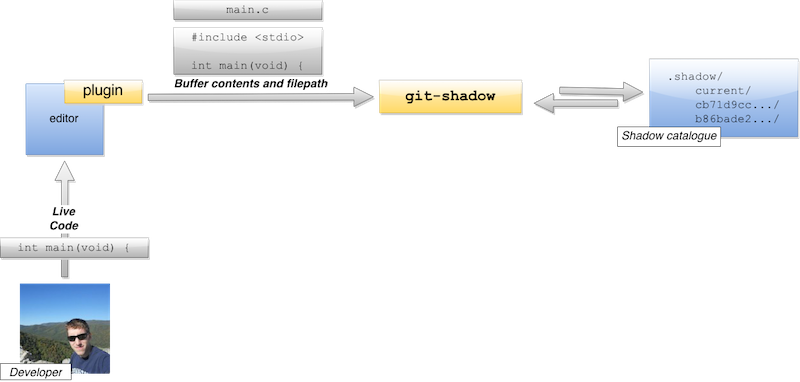
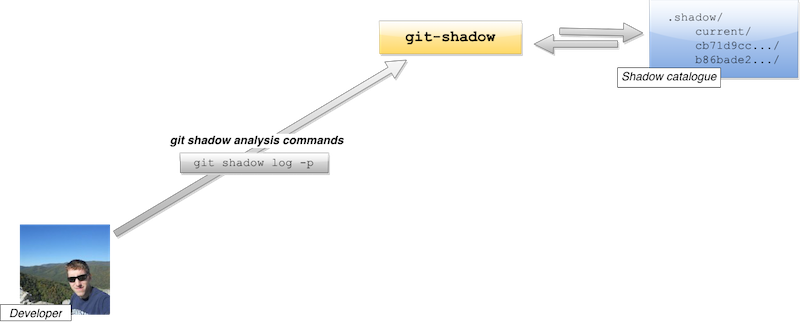
As commits are made to your codebase, git-shadow catalogues git repositories containing your coding activity in the .shadow directory by commit id. The .shadow directory contains a directory for each commit id that git-shadow has been active for, including current.
When the user runs a checkout command, a hook placed in .git/hooks when the user ran the git shadow activate command deletes the existing .shadow/current and replaces it with the directory corresponding to the new HEAD if it exists.
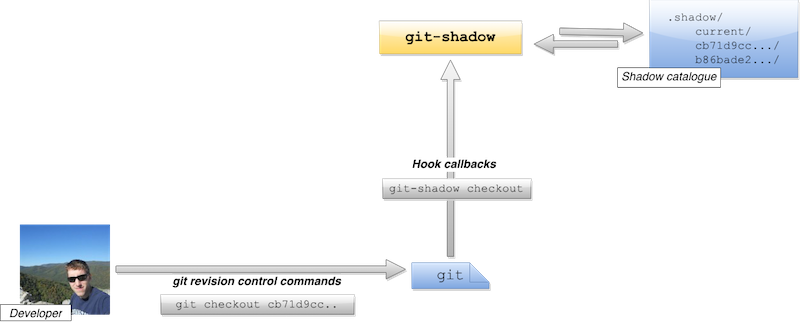
The hook simply calls an incantation of git-shadow -- all of the hook logic is contained in the git-shadow script. Note: This logic probably needs some work.
Running git shadow <git cmd> simply runs the corresponding git command as if it were invoked from .shadow/current.
I've got plans to beat on this, but I haven't done it yet. This script is simply a proof of concept. There is no support for history re-writing (and probably a lot of other git use cases). Re-ordering may work, but squashing/splitting, filter-branch, etc. almost certainly will not.
Jonathan Foote
jmfoote@loyola.edu
24 Jan 2014