
rust-animation is a wgpu-based graphics library written in Rust for creating hardware-accelerated user interfaces. It is designed to implement simple, animated UIs for embedded devices, inspired by the GNOME Clutter project and Apple Core Animation.
- Features
- Prerequisites
- Installation
- Quick Start
- Examples
- API Overview
- Contributing
- License
- Acknowledgments
- 2D Transforms: Apply translate, scale, and rotate transformations to layers
- Rich Animation System: Support for multiple easing functions (Linear, EaseIn, EaseOut, EaseInOut, and various polynomial variants)
- Flex Layout: CSS Flexbox-like layout system using the Stretch library
- Hardware Acceleration: wgpu-based rendering for high performance across multiple backends (Vulkan, Metal, D3D12, OpenGL)
- Layer Hierarchy: Support for nested layers with parent-child relationships
- Event Handling: Built-in event system for keyboard input and focus management
- Image Support: Load and display images as textures
- Text Rendering: Font rendering capabilities for displaying text
- Cross-Platform: Works on Windows, macOS, Linux, and can target WebAssembly
Note: rust-animation is in early development. Some features may be incomplete or have bugs. Please report any issues you encounter.
Before using rust-animation, ensure you have the following installed:
- Rust (stable): Install from rust-lang.org
curl --proto '=https' --tlsv1.2 -sSf https://sh.rustup.rs | sh
sudo apt-get update
sudo apt-get install build-essential cmake pkg-configbrew install cmake- Install CMake from the official website
- Ensure you have the Visual Studio Build Tools or Visual Studio installed
- Ubuntu 20.04 and later
- Windows 10 and later
- macOS (Intel and Apple Silicon)
Add rust-animation to your Cargo.toml:
[dependencies]
rust-animation = "0.2.7"Clone the repository and build:
git clone https://github.com/joone/rust-animation.git
cd rust-animation
cargo build --releaseHere's a minimal example to get started:
use winit::{
    event::{Event, WindowEvent, KeyEvent},
    event_loop::{ControlFlow, EventLoop},
    keyboard::{KeyCode, PhysicalKey},
    window::WindowBuilder,
};
use rust_animation::{layer::Layer, animation::Animation, play::Play};
use rust_animation::layer::LayoutMode;
use rust_animation::animation::EasingFunction;

fn main() {
    // Create event loop and window
    let event_loop = EventLoop::new().unwrap();
    let window = WindowBuilder::new()
        .with_title("My First Animation")
        .with_inner_size(winit::dpi::LogicalSize::new(800, 600))
        .build(&event_loop)
        .unwrap();

    // Create a Play (the main container)
    let mut play = Play::new(
        "My First Animation".to_string(),
        800,
        600,
        LayoutMode::UserDefine,
    );

    // Initialize wgpu context
    play.init_wgpu();

    // Create a stage (the root layer)
    let mut stage = Layer::new("stage".to_string(), 800, 600, None);
    stage.set_visible(true);

    // Create a layer (a visual element)
    let mut layer = Layer::new("my_layer".to_string(), 100, 100, None);
    layer.x = 50;
    layer.y = 50;
    layer.set_color(1.0, 0.0, 0.0); // Red

    // Create and apply an animation
    let mut animation = Animation::new();
    animation.apply_translation_x(50, 400, 2.0, EasingFunction::EaseInOut);
    layer.set_animation(Some(animation));

    // Add layer to stage and stage to play
    stage.add_sub_layer(layer);
    play.add_stage(stage);

    // Event loop
    event_loop.run(move |event, elwt| {
        elwt.set_control_flow(ControlFlow::Poll);

        match event {
            Event::WindowEvent { event, .. } => match event {
                WindowEvent::CloseRequested => elwt.exit(),
                WindowEvent::KeyboardInput {
                    event: KeyEvent {
                        physical_key: PhysicalKey::Code(KeyCode::Escape),
                        ..
                    },
                    ..
                } => elwt.exit(),
                WindowEvent::RedrawRequested => {
                    play.render();
                    window.request_redraw();
                }
                _ => {}
            },
            Event::AboutToWait => {
                window.request_redraw();
            }
            _ => {}
        }
    }).unwrap();
}
For complete working examples, see the Examples section below.
rust-animation includes several examples to demonstrate its capabilities. All examples can be run using cargo:
# General format
cargo run --example <example_name>Example file: easing_functions.rs
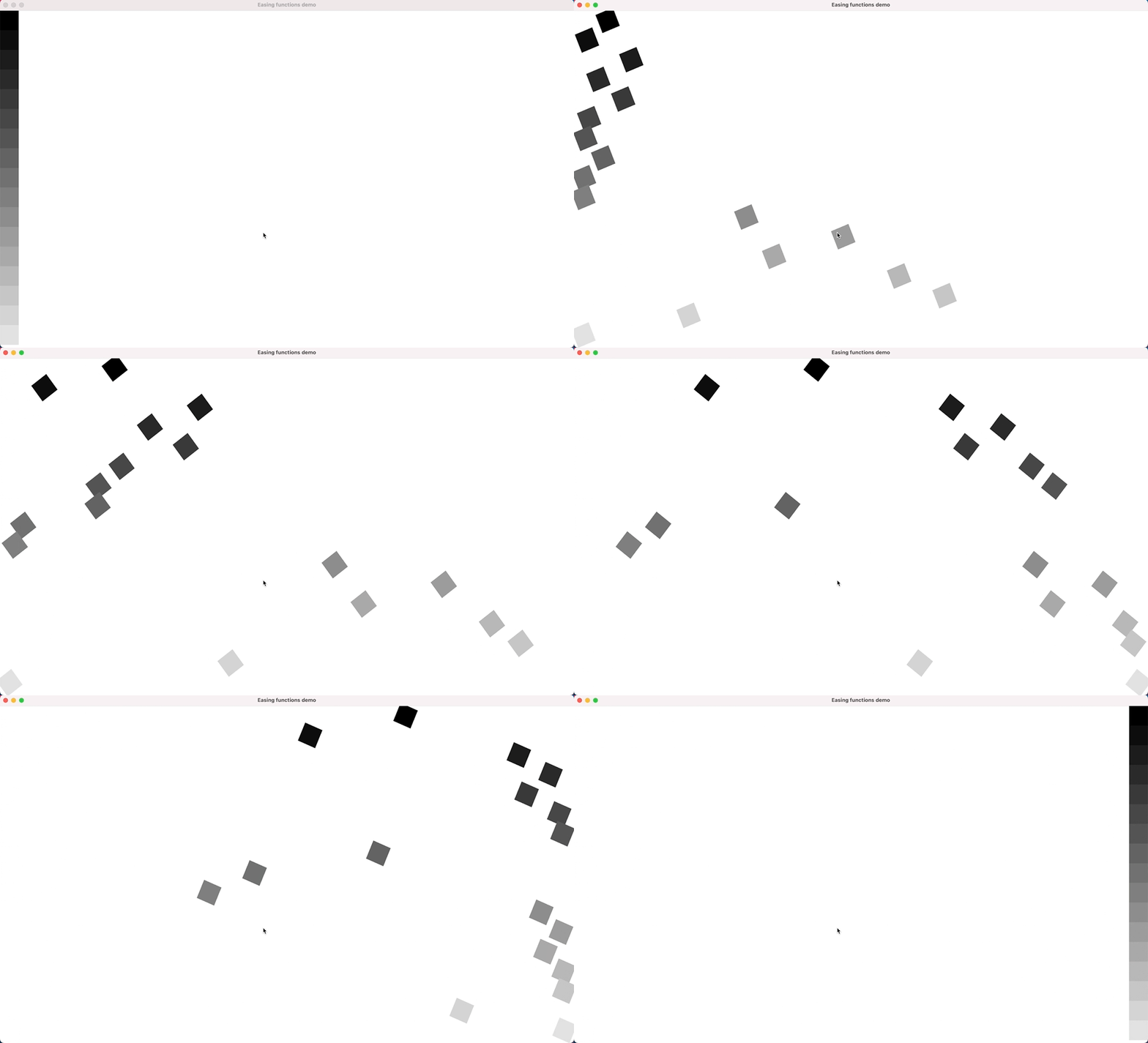
Demonstrates all available easing functions with visual animations.
Run:
cargo run --example easing_functionsWhat it does: Creates 17 animated layers, each using a different easing function, moving horizontally across the screen while rotating.
Key concepts demonstrated:
- Multiple easing functions (Linear, EaseIn, EaseOut, EaseInOut, and polynomial variants)
- Combining multiple animations (translation + rotation)
- Layer positioning and coloring
Code snippet:
  let mut play = Play::new(
    "Easing functions demo".to_string(),
    1920,
    1080,
    LayoutMode::UserDefine,
  );

  // Initialize wgpu context
  play.init_wgpu();

  let mut stage = Layer::new("stage".to_string(), 1920, 1080, None);
  stage.set_visible(true);

  let easing_functions = vec![
    EasingFunction::EaseIn,
    EasingFunction::EaseInCubic,
    EasingFunction::EaseInOut,
    EasingFunction::EaseInOutCubic,
    EasingFunction::EaseInOutQuad,
    EasingFunction::EaseInOutQuart,
    EasingFunction::EaseInOutQuint,
    EasingFunction::EaseInQuad,
    EasingFunction::EaseInQuart,
    EasingFunction::EaseInQuint,
    EasingFunction::EaseOut,
    EasingFunction::EaseOutCubic,
    EasingFunction::EaseOutQuad,
    EasingFunction::EaseOutQuart,
    EasingFunction::EaseOutQuint,
    EasingFunction::Linear,
    EasingFunction::Step,
  ];
  let mut y = 0;
  let time = 5.0;
  let width = 63;
  let height = width;
  for i in 0..17 {
    let layer_name = format!("layer_{}", i + 1);
    let mut layer = Layer::new(layer_name.to_string(), width, height, None);
    layer.x = 0;
    layer.y = y;
    y += height as i32;
    layer.set_color(i as f32 / 18.0, i as f32 / 18.0, i as f32 / 18.0);

    let mut animation = Animation::new();
    animation.apply_translation_x(0, (1920 - width) as i32, time, easing_functions[i]);
    animation.apply_rotation(0, 360, time, EasingFunction::Linear);
    layer.set_animation(Some(animation));
    stage.add_sub_layer(layer);
  }
  play.add_stage(stage);

// Event loop with winit (see full example for complete implementation)Example file: flex_ui.rs
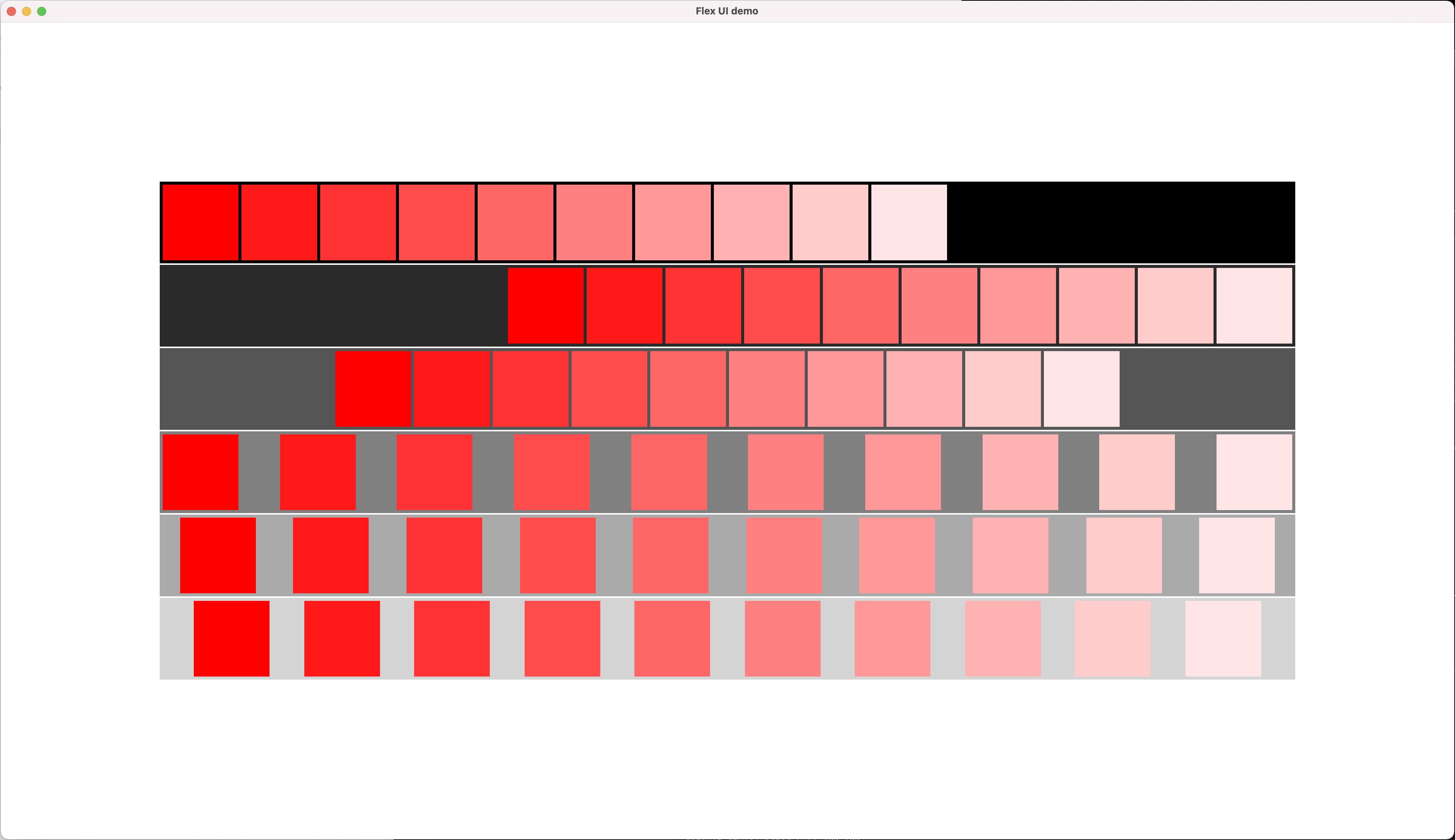
Demonstrates CSS Flexbox-like layout capabilities using the Stretch library.
Run:
cargo run --example flex_uiWhat it does: Creates a responsive layout with multiple containers, each demonstrating different flexbox alignment properties (FlexStart, FlexEnd, Center, SpaceBetween, SpaceAround, SpaceEvenly).
Key concepts demonstrated:
- Flex layout system
- Custom layout implementation using the
Layouttrait - Justify content and align items properties
- Nested layers with flex positioning
See the full implementation in examples/flex_ui.rs.
Example file: ani.rs
Demonstrates basic animation features including transforms and image loading.
Run:
cargo run --example aniWhat it does: Shows multiple animations running simultaneously - scaling, translating, and rotating layers, including image-based layers and colored shapes with nested sub-layers.
Key concepts demonstrated:
- Multiple simultaneous animations (scale, translate, rotate)
- Loading and animating images
- Nested layer hierarchies
- Different easing functions
Code snippet:
  let mut play = Play::new(
    "Animation test".to_string(),
    1920,
    1080,
    LayoutMode::UserDefine,
  );

  // Initialize wgpu context
  play.init_wgpu();

  let mut stage = Layer::new("stage".to_string(), 1920, 1080, None);
  stage.set_visible(true);

  let mut layer_1 = Layer::new("layer_1".to_string(), 400, 225, None);
  layer_1.x = 100;
  layer_1.y = 100;
  layer_1.set_image("examples/splash.png".to_string());

  let mut animation_1 = Animation::new();

  // 1X -> 2X for 5 sec.
  let time = 5.0;
  animation_1.apply_scale(1.0, 2.0, time, EasingFunction::Linear);
  animation_1.apply_translation_x(100, 1000, time, EasingFunction::EaseInOut);
  animation_1.apply_translation_y(100, 300, time, EasingFunction::EaseInOut);
  animation_1.apply_rotation(0, 360, time, EasingFunction::EaseInOut);
  layer_1.set_animation(Some(animation_1));

  let mut layer_2 = Play::new_layer("layer_2".to_string(), 120, 120, None);
  layer_2.x = 100;
  layer_2.y = 100;
  layer_2.scale_x = 1.5;
  layer_2.scale_y = 1.5;
  layer_2.set_color(0.0, 0.0, 1.0);

  let mut animation_2 = Animation::new();
  animation_2.apply_rotation(0, 360, 5.0, EasingFunction::EaseInOut);
  layer_2.set_animation(Some(animation_2));

  let mut layer_3 = Play::new_layer("layer_3".to_string(), 50, 50, None);
  layer_3.x = 10;
  layer_3.y = 10;
  layer_3.set_color(1.0, 0.0, 0.0);
  layer_2.add_sub_layer(layer_3);

  stage.add_sub_layer(layer_1);
  stage.add_sub_layer(layer_2);

  play.add_stage(stage);

// Event loop with winit (see full example for complete implementation)Example file: picture_viewer.rs
Demonstrates event handling and custom user-defined layouts.
Run:
cargo run --example picture_viewerWhat it does: Creates a thumbnail grid viewer with keyboard navigation and focus animations. Currently implements thumbnail view functionality.
Key concepts demonstrated:
- Custom event handlers (EventHandler trait)
- Keyboard input handling (arrow keys for navigation)
- Focus management (key_focus_in/out events)
- Custom layout implementation (Layout trait)
- Grid-based positioning
Note: This example is a work in progress. Currently, only the thumbnail view is fully functional.
Code snippet:
pub struct LayerEvent {
  name: String,
}

impl LayerEvent {
  pub fn new() -> Self {
    LayerEvent {
      name: "layer_event".to_string(),
    }
  }
}

impl EventHandler for LayerEvent {
  fn key_focus_in(&mut self, layer: &mut Layer) {
    let mut animation = Animation::new();
    animation.apply_scale(1.0, 1.1, 0.3, EasingFunction::EaseInOut);
    layer.set_animation(Some(animation));
  }

  fn key_focus_out(&mut self, layer: &mut Layer) {
    layer.scale_x = 1.0;
    layer.scale_y = 1.0;
  }

  fn key_down(&mut self, key: rust_animation::layer::Key, layer: &mut Layer) {
    if key == rust_animation::layer::Key::Right {
      // right cursor
      layer.select_next_sub_actor();
    } else if key == rust_animation::layer::Key::Left {
      // left cursor
      layer.select_prev_sub_actor();
    }
  }
}

pub struct ActorLayout {
  name: String,
  cur_x: i32,
}

impl ActorLayout {
  pub fn new() -> Self {
    ActorLayout {
      name: "actor_layout".to_string(),
      cur_x: 0,
    }
  }
}

impl Layout for ActorLayout {
  fn layout_sub_layers(
    &mut self,
    layer: &mut Layer,
    parent_layer: Option<&Layer>,
    stretch: &mut Option<Stretch>,
  ) {
    println!("layout_sub_layer {}", self.name);
    let mut index: i32 = 0;
    for sub_actor in layer.sub_actor_list.iter_mut() {
      self.cur_x += sub_actor.width as i32;
      sub_actor.x = index % 5 * IMAGE_WIDTH as i32;
      let col = index / 5;
      sub_actor.y = col * IMAGE_HEIGHT as i32;
      index += 1;
    }
  }

  fn update_layout(&mut self, layer: &mut Layer, stretch: &mut Option<Stretch>) {
    println!("update_layout {}", self.name);
  }

  fn finalize(&mut self) {
    println!("finalize {}", self.name);
  }
}Play: The main container and render manager
- Manages the rendering loop
- Holds one or more stages
- Handles projection matrices and wgpu context setup
Layer: Visual elements in the scene graph
- Can have position (x, y, z), size (width, height)
- Supports transforms: translate, scale, rotate
- Can have colors or textures
- Supports nested hierarchies (parent-child relationships)
- Can have animations, event handlers, and custom layouts
Animation: Defines time-based property changes
- Apply transformations over time with easing functions
- Supports: translation (x, y), scaling, rotation
- Multiple animations can run simultaneously on one layer
Easing Functions: Control animation timing curves
- Linear, Step
- EaseIn, EaseOut, EaseInOut (sine-based)
- Quad, Cubic, Quart, Quint variants (polynomial-based)
// Create a Play (main container)
let play = Play::new(name, width, height, layout_mode);

// Create layers
let mut layer = Layer::new(name, width, height, event_handler);
layer.x = x;
layer.y = y;
layer.set_color(r, g, b);
layer.set_image(path);

// Create animations
let mut animation = Animation::new();
animation.apply_translation_x(from, to, duration, easing);
animation.apply_translation_y(from, to, duration, easing);
animation.apply_scale(from, to, duration, easing);
animation.apply_rotation(from_deg, to_deg, duration, easing);
layer.set_animation(Some(animation));

// Build scene graph
parent_layer.add_sub_layer(child_layer);
stage.add_sub_layer(layer);
play.add_stage(stage);

// Render
play.render();Contributions are welcome! Here's how you can help:
- Fork the repository
- Create a feature branch (
git checkout -b feature/amazing-feature) - Commit your changes (
git commit -m 'Add some amazing feature') - Push to the branch (
git push origin feature/amazing-feature) - Open a Pull Request
- Run
cargo fmtbefore committing to ensure consistent code style - Use the provided
run-check-style.shscript for formatting - Write examples to demonstrate new features
- Update documentation for API changes
For information about publishing new versions to crates.io, see RELEASING.md.
Found a bug or have a feature request? Please open an issue with:
- Clear description of the problem/feature
- Steps to reproduce (for bugs)
- Expected vs. actual behavior
- System information (OS, Rust version)
This project is licensed under the BSD-3-Clause License - see the LICENSE file for details.
This project was inspired by:
- GNOME Clutter - A GObject-based graphics library
- Apple Core Animation - Animation infrastructure for macOS and iOS
rust-animation uses several excellent open-source libraries:
- cgmath - Linear algebra and mathematics for graphics
- wgpu - Modern cross-platform graphics API
- image - Image encoding and decoding
- keyframe - Keyframe animation library
- stretch - Flexbox layout engine
- ab_glyph - Font rendering
- winit - Window creation and event loop (examples only)
Author: Joone Hur
Repository: https://github.com/joone/rust-animation