





ETE (Environment for Tree Exploration) is a toolkit that assists in the automated manipulation, analysis and visualization of trees. It is mainly written in Python, and includes many extra functionalities for phylogenetic trees.
Its main features include:
- Read and write support for trees in Newick format
- Multiple functions for traversing, searching and manipulating tree topologies and node annotations
- Integration with NCBI Taxonomic database
- Integration with GTDB database
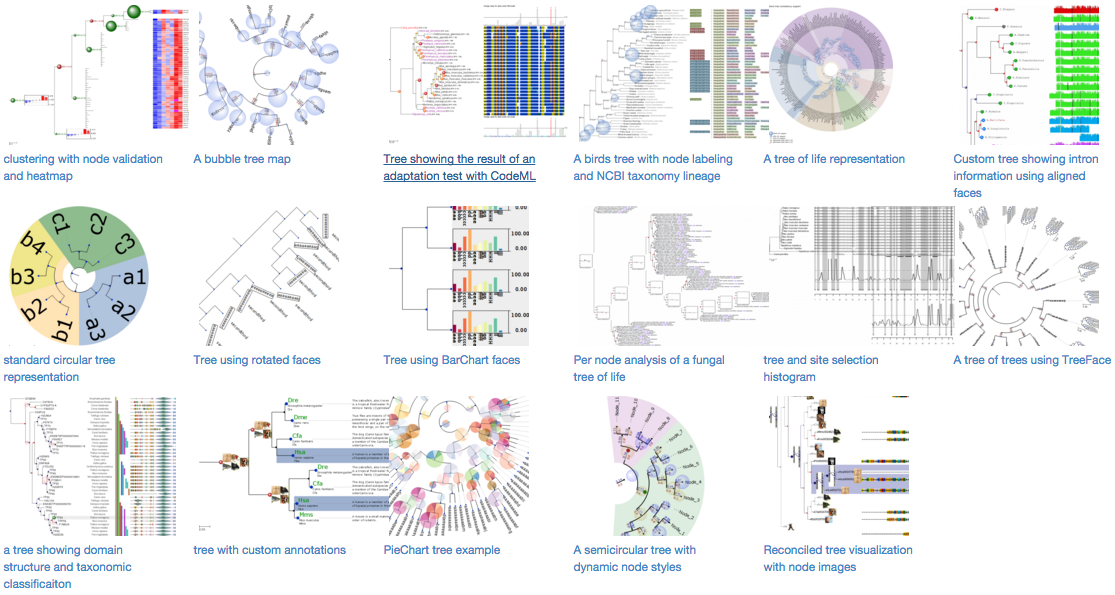
- Programmatic visualization framework
- Visualization of huge trees based on adaptive zooming
- Comparing trees
- Phylogenetic functions
- orthology detection
- phylogenetic distance?
- Command line tools
- phylogenetic reconstruction protocols
- tree comparison
- tree diff
If you use ETE, please cite:
Jaime Huerta-Cepas, François Serra and Peer Bork. "ETE 3: Reconstruction,
analysis and visualization of phylogenomic data."  Mol Biol Evol (2016) doi:
10.1093/molbev/msw046
The official website of ETE is http://etetoolkit.org. You can find downloading instructions and further documentation there, or in the next subsection specifically for ETE v4.
News and announcements are usually posted on twitter: http://twitter.com/etetoolkit
To start
- Clone this repo to local computer with
git clone https://github.com/etetoolkit/ete.git(orgit clone git@github.com:etetoolkit/ete.gitif you have the right permissions) - Change to ete4 branch
git checkout ete4 - Install dependecies
- Build and install ete4 from repo's root directory:
pip install -e .
(In Linux there may be some cases where the gcc library must be
installed, which can be done with conda install -c conda-forge gcc_linux-64)
Rather than sending direct support-related emails to the developers, it is better to keep the communication public.
For question on how to use ETE in the bioinformatics context, use
Biostars with the etetoolkit tag, or stack
overflow.
For bug reports, feature requests and general discussion, use https://github.com/etetoolkit/ete/issues
For more technical problems, you can also use the official ETE mailing list at https://groups.google.com/d/forum/etetoolkit. To avoid spam, messages from new users are moderated. Expect some delay until your first message appears after your account is validated.
For any other inquiries (collaborations, sponsoring, etc), please contact jhcepas@gmail.com.