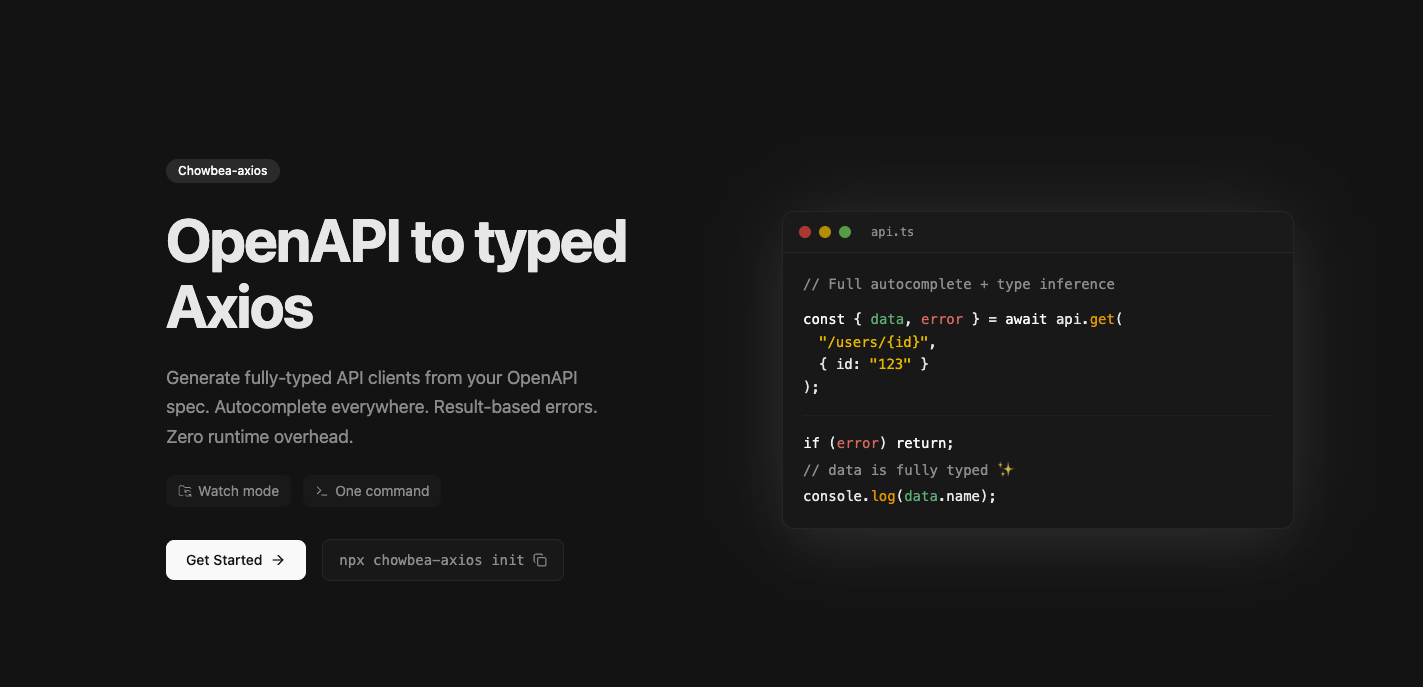
Turn your OpenAPI spec into a fully-typed Axios client. One command.


# Initialize and configure (interactive)
npx chowbea-axios init

# Fetch spec and generate client
npx chowbea-axios fetch
Or with your preferred package manager:
pnpm dlx chowbea-axios init
yarn dlx chowbea-axios init
bunx chowbea-axios init
Then import and use:
import { api } from "./src/api/api.client";

const { data, error } = await api.op.getUserById({ id: "123" });

if (error) return console.error(error.message);

console.log(data.name); // ✨ Fully typed- Zero manual types — Generated directly from your OpenAPI spec
- Full autocomplete — Every endpoint, parameter, and response
- Result-based errors —
{ data, error }instead of try/catch - Watch mode — Auto-regenerate when your spec changes
- YAML or JSON — Both spec formats accepted at every entry point
- Interactive TUI — Run
chowbea-axios(no args) for the dashboard - CI-friendly —
--non-interactivemode plus a hardened workflow template
The default output folder is src/api/. Override it via output.folder in api.config.toml.
src/api/
├── _internal/
│   ├── openapi.json         # Cached spec (always JSON)
│   └── .api-cache.json      # Cache metadata (hash, timestamp)
├── _generated/              # Always overwritten — do not edit
│   ├── api.types.ts         # OpenAPI-typed paths/components/operations
│   ├── api.operations.ts    # Typed apiClient.op.<id>(...) methods
│   └── api.contracts.ts     # Concrete interfaces (cmd+click navigation)
├── api.client.ts            # Typed HTTP client (editable, generated once)
├── api.instance.ts          # Axios instance + auth interceptor (editable, generated once)
├── api.error.ts             # Result-based error handling (editable, generated once)
└── api.helpers.ts           # Path-based type helpers (editable, generated once)
| Command | Description |
|---|---|
init |
Interactive setup — creates config and base files |
fetch |
Fetch spec from endpoint (or local file) and generate types |
generate |
Generate from cached/local spec |
watch |
Watch for spec changes and auto-regenerate (with backoff on failures) |
status |
Show current config, cache, and generated-file status |
validate |
Validate your OpenAPI spec — 7 categories, severity-classified |
diff |
Compare cached vs new spec; flags schema/parameter/response changes |
plugins |
Manage Vite codegen plugins (Surfaces, Side Panels) |
Run chowbea-axios <command> --help for command-specific flags.
Running chowbea-axios with no command launches an OpenTUI dashboard with screens for fetch, generate, diff, validate, watch, plugins, env management, and an endpoint inspector. Tabs survive screen navigation, and processes (e.g. npm run dev) can be run alongside in the process tab.
The dashboard requires Bun. When invoked under Node, the CLI re-launches itself under Bun automatically. If Bun isn't installed, the CLI falls back to headless mode and prints a hint.
Configure how the generated client attaches auth tokens via the [instance] block in api.config.toml:
[instance]
auth_mode = "bearer-localstorage"   # SPA pattern — reads from localStorage
# auth_mode = "custom"              # TODO interceptor — implement your own
# auth_mode = "none"                # No interceptor
token_key = "auth-token"            # localStorage key (bearer-localstorage only)
with_credentials = false            # Send cookies cross-origin (default: false)
timeout = 30000
base_url_env = "API_BASE_URL"       # Env var holding the base URL
env_accessor = "process.env"        # or "import.meta.env" for Vite
For fetching the spec itself with HTTP Basic Auth (e.g. private staging endpoints), add a [fetch.auth] block:
[fetch.auth]
type = "basic"
username = "$SWAGGER_USER"          # $VAR or ${VAR} env interpolation
password = "$SWAGGER_PASS"
When the env vars aren't set, the CLI prompts interactively. In CI, set them in the environment.
The init wizard offers to scaffold .github/workflows/chowbea-axios-ci.yml — a hardened workflow that re-fetches your spec on every PR and fails when the generated client is out of date. The template includes:
permissions: contents: read(default-deny)concurrencycancel-in-progress- Node 22 + npm cache (works for every package manager — see comments for bun/pnpm/yarn variants)
varsorsecretsfallback forSTAGING_API_ENDPOINT
For non-interactive bootstrapping (e.g. project starters):
chowbea-axios init --non-interactive \
  --endpoint https://staging.example.com/openapi.json \
  --output-folder src/api \
--package-manager npmchowbea-axios/vite exposes two codegen plugins for Vite projects:
surfacesCodegen()— auto-discovers*.surface.tsxfiles and generates a typed barrelsidepanelsCodegen()— same for*.panel.tsxfiles
Scaffold them via chowbea-axios init --with-vite-plugins or chowbea-axios plugins --setup. See docs for the full registry pattern.
If chowbea-axios helps you ship faster, consider giving it a star! It helps others discover the project and motivates continued development.

MIT