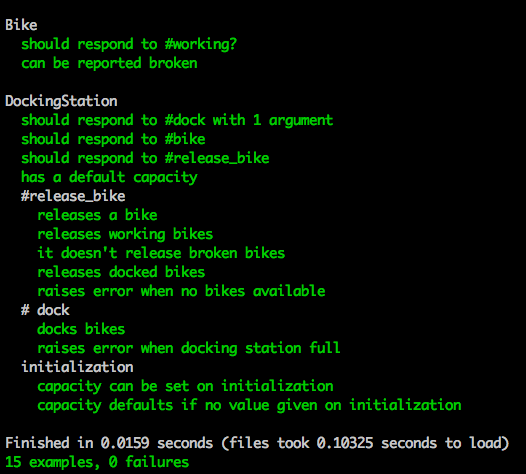
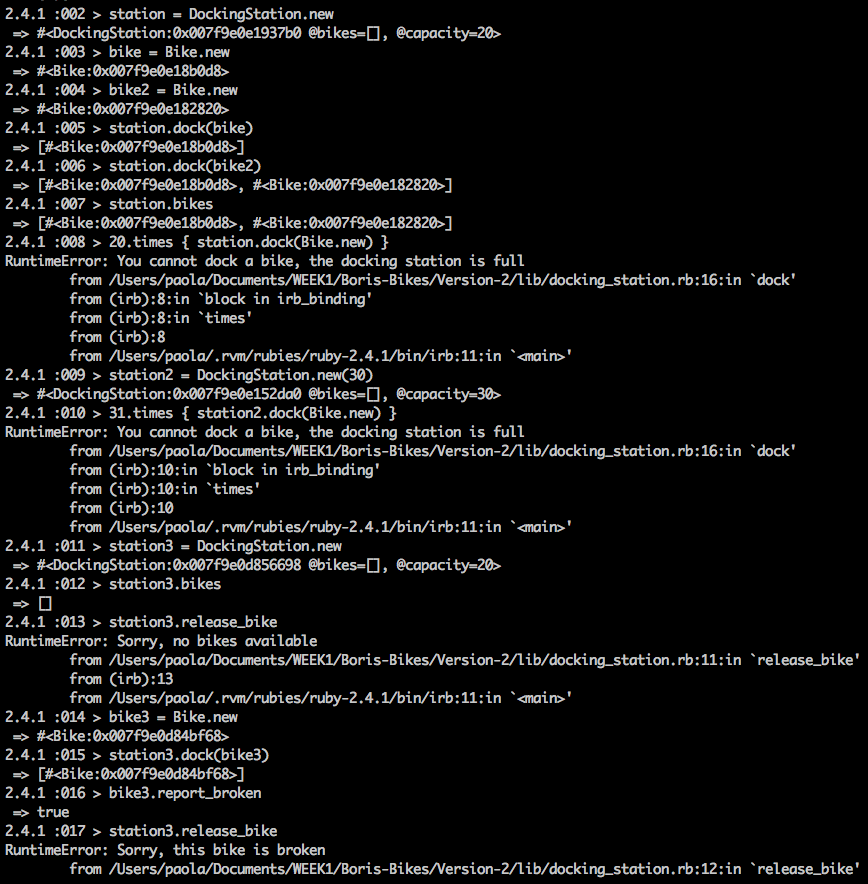
This is a program that emulates the Boris Bikes scheme in London.
Version 1 was written in February 2018 during week 1 of the Makers Academy course.
Version 2 was written in May 2018 to improve the code (refactoring, single responsibility principle, test doubles, guard conditions) and to practise git flow (branching, pull requests, merging).
The following information applies to the second version:
As a person,
So that I can use a bike,
I'd like a docking station to release a bike.

As a person,
So that I can use a good bike,
I'd like to see if a bike is working.

As a member of the public
So I can return bikes I've hired
I want to dock my bike at the docking station.

As a member of the public
So I can decide whether to use the docking station
I want to see a bike that has been docked.

As a member of the public,
So that I am not confused and charged unnecessarily,
I'd like docking stations not to release bikes when there are none available.

As a maintainer of the system,
So that I can control the distribution of bikes,
I'd like docking stations not to accept more bikes than their capacity.

As a system maintainer,
So that I can plan the distribution of bikes,
I want a docking station to have a default capacity of 20 bikes.

As a system maintainer,
So that busy areas can be served more effectively,
I want to be able to specify a larger capacity when necessary.

As a member of the public,
So that I reduce the chance of getting a broken bike in future,
I'd like to report a bike as broken when I return it.

As a maintainer of the system,
So that I can manage broken bikes and not disappoint users,
I'd like docking stations not to release broken bikes.

As a maintainer of the system,
So that I can manage broken bikes and not disappoint users,
I'd like docking stations to accept returning bikes (broken or not).
- from user stories to domain model
- using the domain model to feature-test a feature
- writing a unit test and watching it fail
- implementing code to pass the test
- refactoring
RSpec
(