This page contains the analysis scripts referring to our Article entitled 'Individual differences in inhibitory control are not related to downregulation of negative emotion via distancing' published in Emotion. We provide a reproducible and portable R environment, all statistical analysis scripts, and the original dataset to re-run our code. Please find additional materials on the OSF.
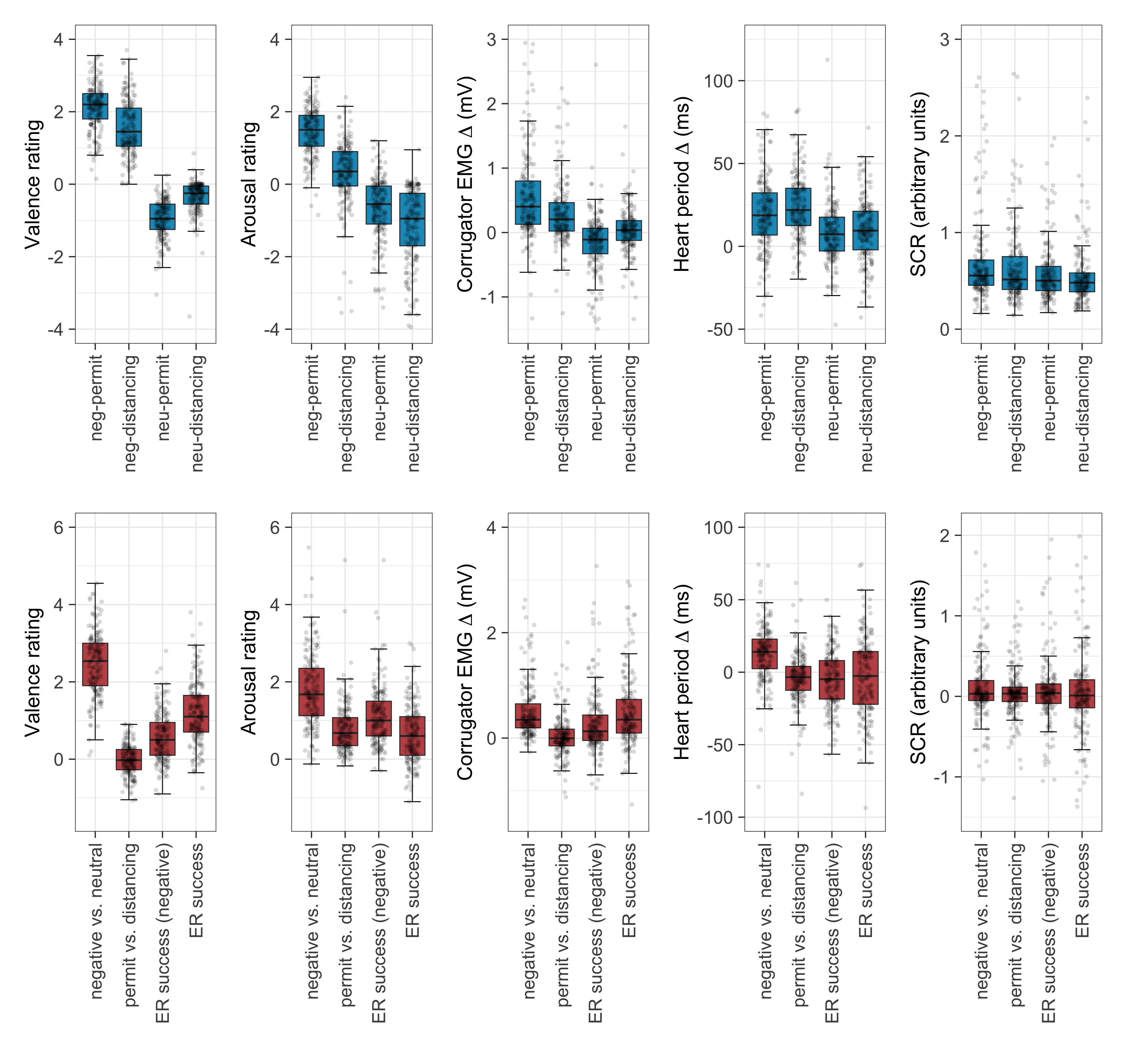
Evidence suggests that cognitive control and emotional control share partly the same cognitive processes. For example, downregulation of negative emotions requires inhibiting or limiting the expression of a prepotent appraisal of a situation in favor of selecting an alternative appraisal. Although inhibitory control seems to be a particularly relevant process in emotion regulation (ER), previous studies reported inconsistent findings on their relationship, likely because of the application of single task measures in relatively small samples. Therefore, this study implemented a battery of six commonly used inhibitory control tasks in a large sample of young healthy adults (N = 190) and investigated whether inhibitory control is associated with the downregulation of negative emotion. ER was measured via self-reported reappraisal and suppression use and via a laboratory ER task where participants had to distance themselves from emotions in response to negative and neutral pictures. The ER task was accompanied by concurrent physiological measurements of corrugator electromyography (EMG), skin conductance response (SCR), and heart period (HP). Frequentist and Bayesian analyses indicated that inhibitory control was neither associated with self-reported reappraisal and suppression use, nor with successful downregulation of negative emotion via distancing. Compared with HP and SCR, corrugator EMG was the only peripheral physiological measure that was indicative of regulatory success. The findings question the view that inhibitory control represents an underlying process in emotion regulation via distancing, at least at the behavioral level. Further studies should investigate the generalizability of these findings to other ER strategies, tactics, paradigms, and participant groups.
Keywords: emotion regulation; reappraisal; inhibitory control; cognitive control; peripheral physiology
code/ - contains all analysis scripts as well as their associated derivatives, tables and figures
data/ - contains raw data or imported data files from completed projects on which the current analyses are based
renv/ - contains a single file to initiate the R environment (the scripts located in code/ refer to this file)
renv.lock - a list of R packages automatically downloaded and attached to the R environment of this project
setwd.sh - a script to automatically set the working directory in all analysis scripts
In order to reproduce our statistical analyses, you should first navigate to the folder where you want the data to be stored (avoid paths with spaces) and clone this repository via the following commands (to be entered in command line):
git clone https://github.com/pjawinski/emotion.git
cd emotion
You may then update the specified working directory in each analysis script via the following command:
./setwd.sh
You are now ready to run all scripts located in code/ according to their numbering one after another. R scripts can be run from command line or from within RStudio. The R environment is activated by the scripts and required packages are downloaded automatically. If you do not have an SPSS license, you may skip the respective SPSS script and continue with the next R script. Our repository comes along with all files derived from the scripts, so that you can basically start from wherever you wish.