UK-style election simulator demonstrating a first-past-the-post voting system. Features voter registration, candidate management, vote casting, and result tallying. Built with Spring Boot, this project highlights backend architecture, data handling, application logic, and system workflow implementation.
- Java, MySQL
- Spring Boot 3 (Web)
- Spring Data JPA
- JUnit, Mockito, MockMVC
- Swagger (OpenAPI)
- Api documentation
- SLF4J (logging)
- Postman (API & performance testing)
- SonarQube (code quality analysis)
- Maven
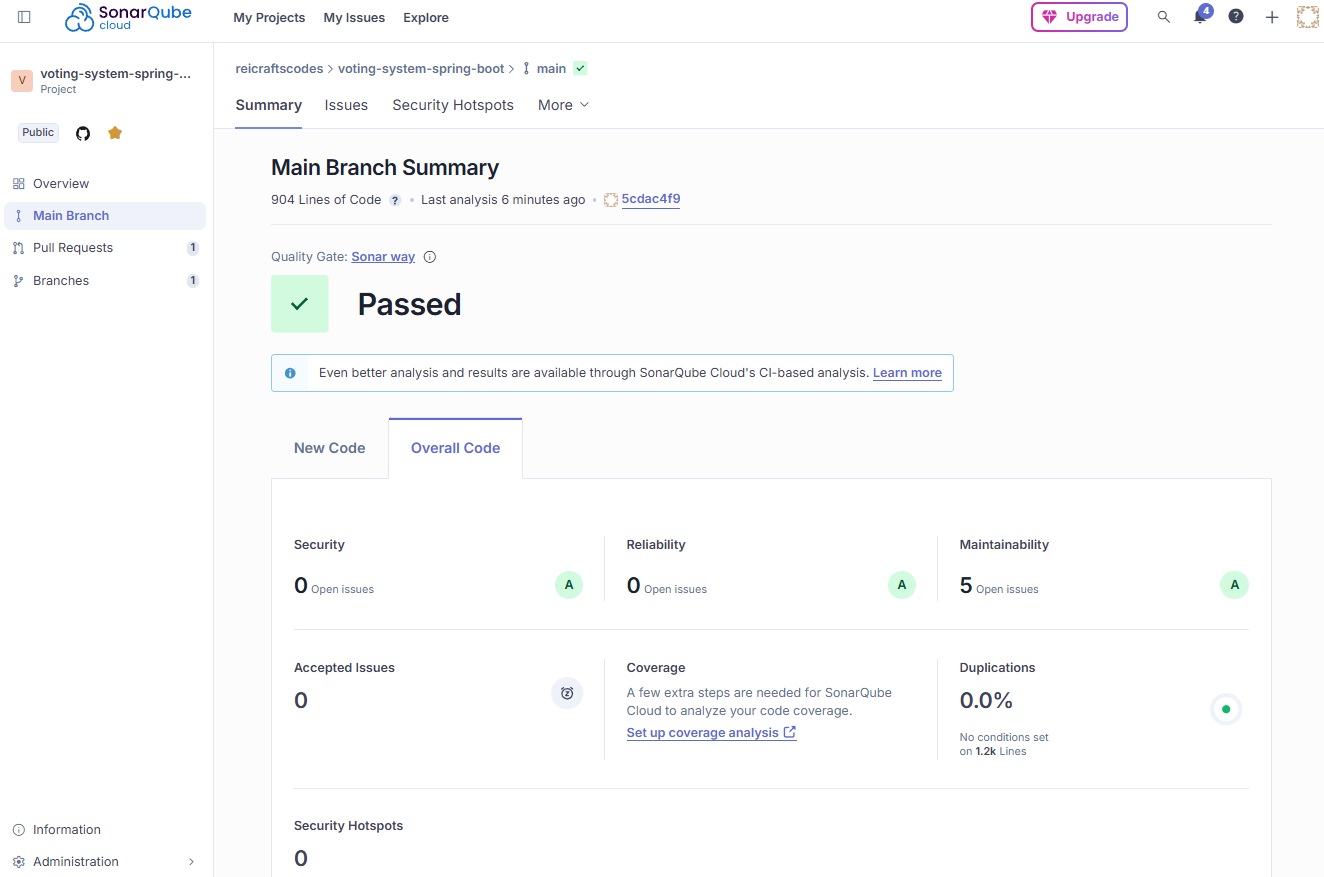
This project is also being actively checked with Sonarqube integrated in the developer's IDE. An analysis with SonarQube to would reveal the following:
The backend follows a layered architecture:

-
Controller Layer
- Handles HTTP requests/responses
- Delegates business logic to the service layer
- Examples:
VotingController,UserDetailsController,PartyListController
-
Service Layer (Interface + Implementation)
- Interfaces define available operations (
VotingService,UserDetailsService,PartyListService) - Implementations (
VotingServiceImpl, etc.) contain business logic, validation, and repository calls - Benefits: abstraction, testability, and flexibility for future extensions
- Interfaces define available operations (
-
Repository Layer
- Handles database interactions via Spring Data JPA
- Examples:
VotingRepository,UserDetailsRepository,PartyListRepository - Custom queries used for aggregate functions, like total votes per party
- Each user can vote only once (
user_details_idis unique invotingtable) - Application and database validation prevent duplicates
- Guarantees safe concurrent operations
- Only users 18+ can vote
- Validated against National Insurance Number and Last Name
- Custom exceptions for meaningful feedback
- Vote counts use Long to safely support large-scale elections
- Aggregation handled efficiently in the service layer
/api/v1/voting→ cast votes, get receipts, retrieve totals/api/v1/users→ manage voters (CRUD)/api/v1/uk/parties→ manage party lists
- Critical actions logged with SLF4J
- Supports debugging, auditing, and transparency
The services below have their own Swagger OpenAPI specifications, in order access the API Docs locally copy and paste the following url http://localhost:8080/swagger-ui/index.html
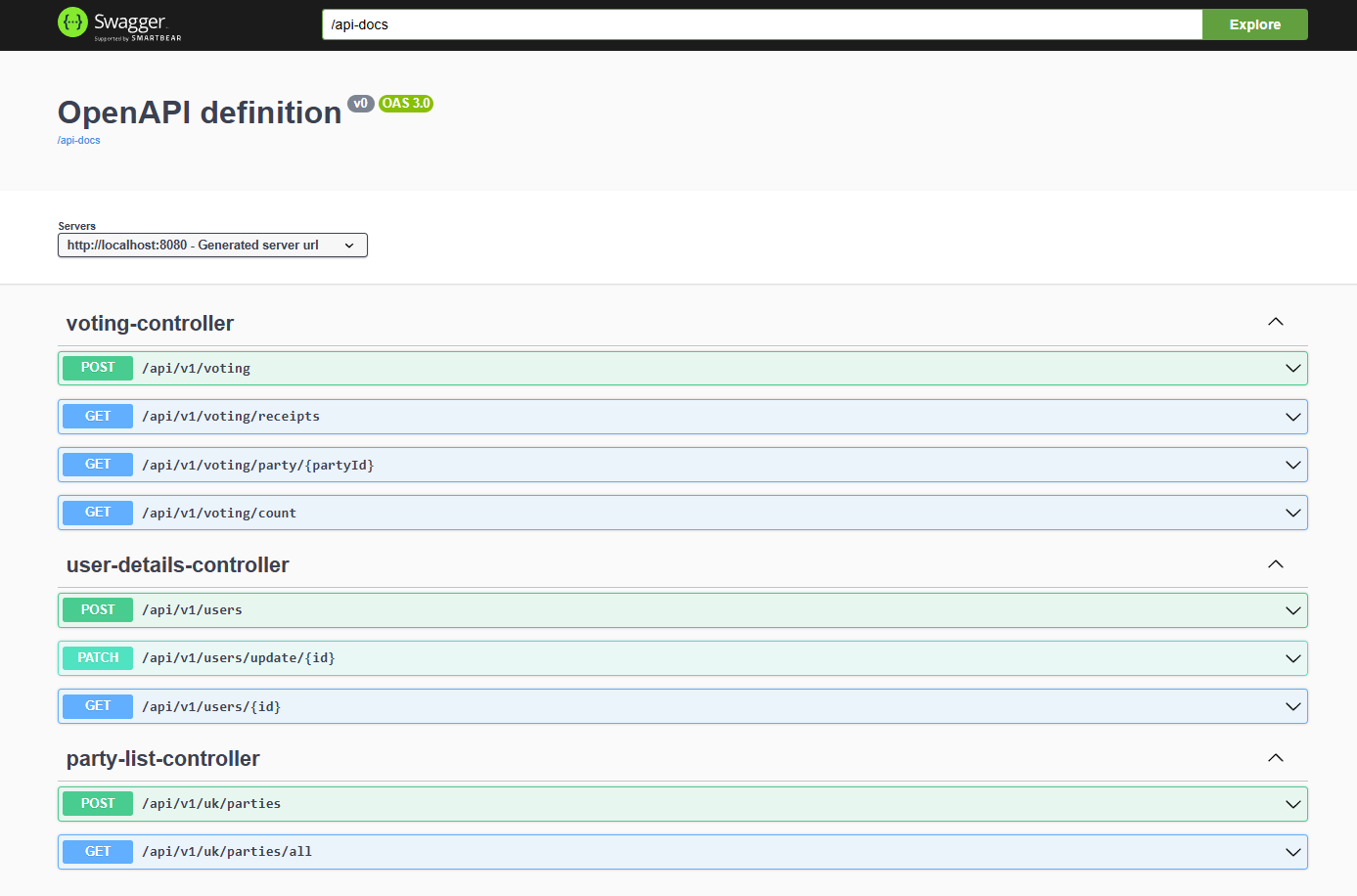
http://localhost:8080/api/v1
| Endpoint | Method | Parameter | Type | Description |
|---|---|---|---|---|
/users |
POST | userDetails |
Object (JSON) | Create a new user with personal details |
/users/{id} |
GET | id |
Integer | Retrieve a user’s personal details |
/users/update/{id} |
PATCH | id |
Integer | Update an existing user’s details |
/users/update/{id} |
PATCH | updateDetailsDto |
Object (JSON) | Fields to update for the user |
Example JSON for creating a user:
{
  "firstName": "John",
  "lastName": "Doe",
  "dateOfBirth": "1990-01-01",
  "nationalInsuranceNumber": "AB123456C"
}| Endpoint | Method | Parameter | Type | Description |
|---|---|---|---|---|
/uk/parties |
POST | partyList |
Object (JSON) | Create a new political party |
/uk/parties/all |
GET | — | — | Retrieve all party members |
Example JSON for creating a party:
{
  "partyName": "Example Party",
  "position": "Leader"
}This is a simple test scenario to learn how APIs behave under load. We simulate multiple users casting votes at the same time to understand.
Note: focus is on understanding API performance basics rather than achieving high-scale testing.
| Endpoint | Method | Parameter | Type | Description |
|---|---|---|---|---|
/voting |
POST | request |
Object (JSON) | Cast a vote for a party |
/voting/receipts |
GET | — | — | Fetch all voting receipts |
/voting/count |
GET | — | Long | Get total number of votes |
/voting/party/{partyId} |
GET | partyId |
Integer | Get total votes for a specific party |
Example JSON for casting a vote:
{
  "nationalInsuranceNumber": "AB123456C",
  "lastName": "Doe",
  "partyId": 1
}This project is also being actively checked with Sonarqube integrated in the developer's IDE. An analysis with SonarQube to would reveal the following:
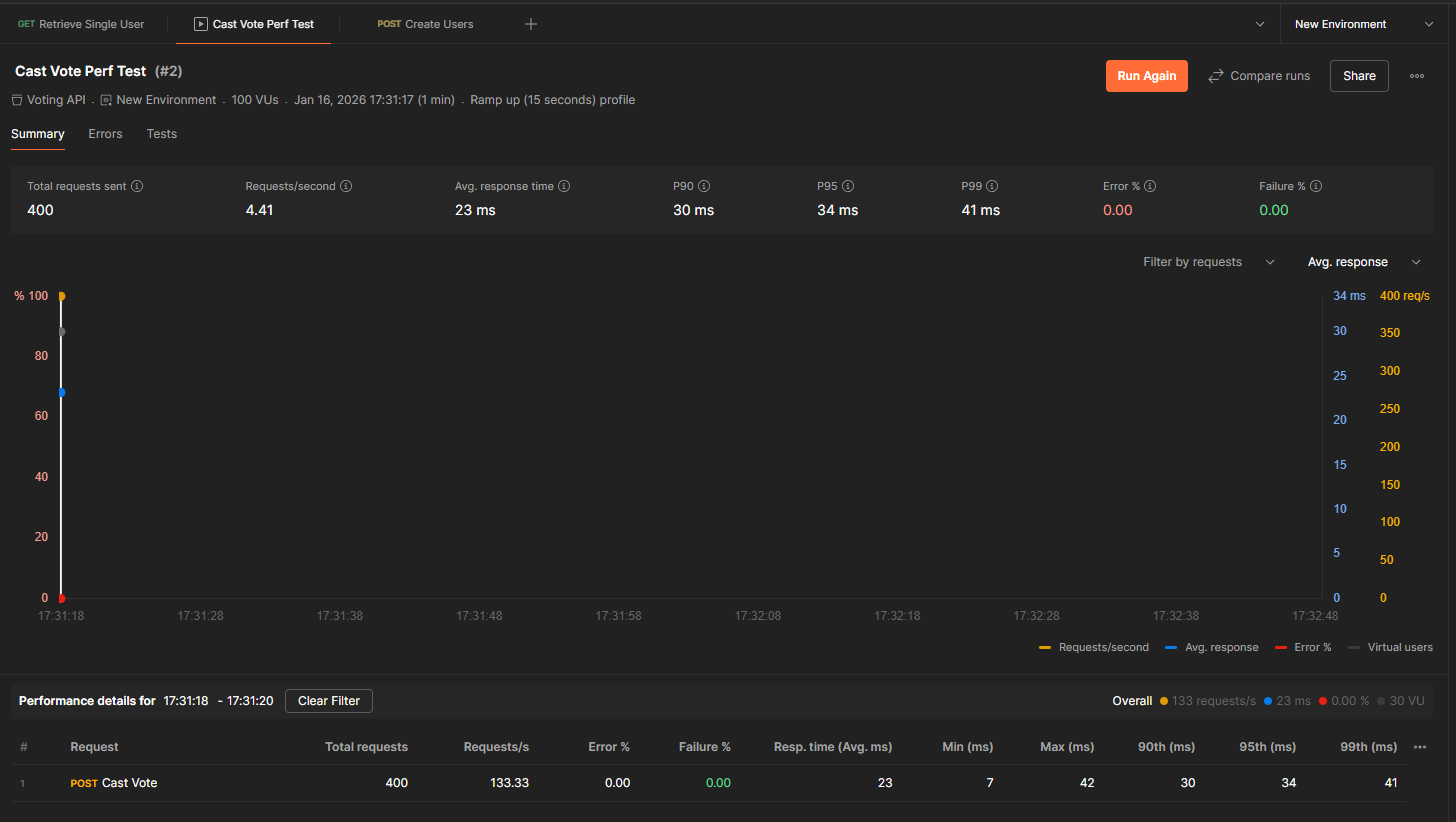
- Simulated multiple users casting votes concurrently
- Monitored API response times and errors
Example Metrics:
- Requests/sec: 133.33
- Average response time: 23 ms
- P90 response time: 30 ms
- Error %: 0.00%
- AWS RDS / Aurora for database
- AWS Elastic Beanstalk for deployment
This project is not suitable for real elections.
@reicraftscodes