

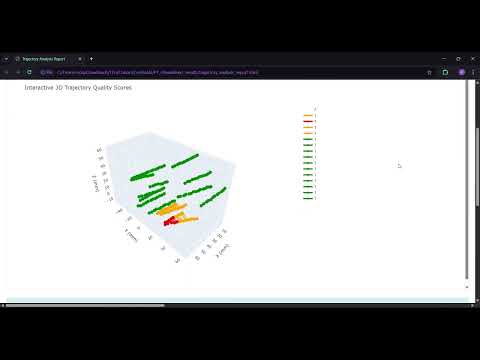
🎥 Click the image to watch the SEEG trajectory demo
This repository contains the core algorithms, software architecture, and implementation details for automated SEEG (Stereoelectroencephalography) electrode localization and trajectory reconstruction. The system employs a novel multi-stage ensemble approach combining deep learning-based brain extraction, adaptive image enhancement, global voting consensus, and machine learning-based confidence estimation to achieve sub-millimeter localization accuracy (mean error: 0.33 mm).
🌐 View Project Website - Professional presentation with thesis, technical documentation, and repository ecosystem.
For end-users and clinical deployment, please refer to SlicerSEEG - the production-ready 3D Slicer extension.
For complete research documentation, see the full bachelor's thesis included in this repository.
This repository serves as the research and development foundation for the SEEG electrode localization system. It contains:
- Algorithm implementations and experimental code
- Software architecture and design patterns
- Pipeline development and optimization
- Research validation scripts and analysis
- Technical documentation for developers and researchers
The companion repository SlicerSEEG provides the packaged extension for clinical users, while this repository focuses on the underlying computational methods and technical implementation.
- System Architecture
- Algorithm Details
- Machine Learning Models
- Repository Structure
- Experimental Results
- Technical Implementation
- Development
- Research Context
- Citation
The system implements a modular pipeline architecture with distinct processing stages:
INPUT: MRI + CT volumes
    ↓
[1] Brain Extraction → [2] Multi-Modal Enhancement → [3] Ensemble Voting
    ↓
[4] Centroid Detection → [5] Confidence Scoring → [6] Trajectory Reconstruction
    ↓
OUTPUT: Electrode positions + trajectories + confidence scores
Algorithm: Otsu thresholding with morphological refinement
Implementation: Brain_mask_methods/brain_mask_extractor_otsu.py
Processing steps:
- Gaussian smoothing (σ=2.0) - Noise reduction
- Otsu's thresholding - Automatic threshold selection
- Morphological closing (6 iterations, connectivity-1 structure) - Structure connection
- Binary hole filling - Internal cavity completion
Output: Binary brain mask (uint8, 0/1 values)
Key parameters:
threshold_value: 20 (fallback threshold)sigma: 2.0 (Gaussian smoothing)closing_iterations: 6
Implementation: Threshold_mask/ctp_enhancer.py, Threshold_mask/enhance_ctp.py
Purpose: Maximize electrode contrast across varying CT acquisition parameters
The system applies 7 parallel enhancement pipelines, generating ~38 enhanced volume variants:
- Gaussian filtering (σ=0.3)
- Gamma correction (γ=3)
- High-pass sharpening (strength=0.8)
- ROI masking × gamma correction
- CLAHE (Contrast Limited Adaptive Histogram Equalization)
- Clip limit: 2.0
- Tile grid: (3, 3)
- Wavelet denoising (Daubechies-1) + Non-local means
- Wavelet-only denoising (db1)
- Conservative gamma correction (γ=0.8)
Complex 10-step pipeline:
- Gaussian (σ=0.3) → Gamma (γ=0.8) → Top-hat morphology → Sharpening
- LOG transform (c=3) → Wavelet (db4) → Morphological erosion
- Combined wavelet + non-local means denoising
Multi-stage enhancement:
- Gaussian (σ=0.3) → Gamma (γ=2) → Sharpen → Wavelet
- Gaussian (σ=0.4) → Gamma (γ=1.4)
- Top-hat transform
14-step complex chain:
- Gaussian → Top-hat → Subtraction → Gamma (γ=5)
- Sharpening → Opening → Closing → Erosion
Enhancement techniques employed:
- Gaussian filtering: σ ∈ {0.1, 0.2, 0.3, 0.4, 0.8}
- Gamma correction: γ ∈ {0.8, 1.2, 1.4, 2, 3, 5}
- CLAHE: clipLimit=2.0, tileGridSize=(3,3)
- Wavelet denoising: db1, db4 wavelets, soft thresholding
- Non-local means: patch_size=2-5, patch_distance=2-6
- High-pass sharpening: strength=0.4-0.8
- LOG transform: c ∈ {3, 5}
- Morphological operations: top-hat, opening, closing, erosion
Rationale: Different enhancement methods optimize for different CT protocols and image quality levels.
Adaptive Thresholding (Threshold_mask/ctp_enhancer.py)
Algorithm: Machine learning-based threshold prediction
Feature extraction (33 statistical features):
- Basic statistics: min, max, mean, median, std
- Percentiles: p25, p75, p95, p99, p99.5, p99.9, p99.99
- Distribution metrics: skewness, kurtosis
- Non-zero statistics: mean, median, std, count, ratio
- Histogram analysis: peak detection, peak distance, entropy
- Engineered features: IQR, contrast ratio, CV
Model: Random Forest ensemble (random_forest_modelP1.joblib)
- Input: 33 statistical features
- Output: Optimal threshold value
- Fallback: 99.97th percentile if prediction out of range
Ensemble Voting (Masks_ensemble/masks_fusion_top.py)
Algorithm: Global voting with greedy mask selection
Process:
- Mask generation: Apply predicted threshold to all 38 enhanced volumes
- Global vote map:
vote_map[voxel] = Σ(mask_i[voxel])(range: 0-38) - Best mask selection: Greedy algorithm selecting top 4 masks
- Score:
weighted_overlap / mask_sum - Higher agreement with consensus → higher score
- Score:
- Consensus formation: Threshold at 35% agreement
consensus_mask = (vote_map >= 0.35 × num_masks)
Output masks:
- Top mask 1 & 2: Highest quality individual masks
- Consensus mask: 35% voting threshold
- Weighted fusion: Score-weighted combination
Centroid Extraction
Algorithm: Connected component analysis
- Implementation:
skimage.measure.label+regionprops - Centroid calculation: Center of mass per component
- Coordinate conversion: Voxel IJK → Physical LPS → RAS
Feature Extraction (Centroids_pipeline/centroids_feature_extraction.py)
Total features: 22 (20 numerical + 2 categorical)
RAS_X,RAS_Y,RAS_Z: 3D position in RAS coordinate system
- ROI extraction: radius=2 voxels around centroid
CT_mean_intensity,CT_std_intensityCT_max_intensity,CT_min_intensity
PCA1,PCA2,PCA3: First 3 principal components- Implementation:
sklearn.decomposition.PCA(n_components=3)
dist_to_surface: Distance to brain ROI surface- Marching cubes surface extraction
- KDTree nearest neighbor search
dist_to_centroid: Distance to global centroidx_relative,y_relative,z_relative: Relative position
mean_neighbor_dist: Average distance to neighborsn_neighbors: Count within 7mm thresholdkde_density: Gaussian KDE (Scott's bandwidth)
Louvain_Community: Graph-based clustering- Algorithm: Louvain modularity optimization
- Edge weight:
1/distance
Pixel_Count: Voxels in connected componentHemisphere: "Left" or "Right" (based on X coordinate)has_neighbors: Boolean flag
Implementation: confidence.py, Centroids_pipeline/model_application.py
Model Architecture: Patient Leave-One-Out Ensemble
File: patient_leave_one_out_ensemble.joblib (9.1 MB)
Structure:
- PatientEnsemblePipeline: 8 patient-specific models
- Individual models: LightGBM regressors
- Preprocessor: ColumnTransformer
- Numerical features: StandardScaler
- Categorical features: OneHotEncoder
Prediction algorithm (predict_leave_one_out):
def predict(test_data, exclude_patient):
    predictions = []
    weights = []

    for patient_model in ensemble:
        if patient_model.id != exclude_patient:
            pred = patient_model.predict(test_data)
            weight = patient_model.validation_score
            predictions.append(pred * weight)
            weights.append(weight)

    return sum(predictions) / sum(weights)
Leave-one-out strategy: When analyzing patient P8, uses models trained on P1-P7.
Output:
Ensemble_Confidence: Continuous score (0-1)Binary_Prediction: Binary classification (≥0.5 = electrode)Confidence_Rank: Ranking by confidence
Confidence thresholds:
- High (≥0.8): Direct clinical use
- Medium (0.6-0.8): Review recommended
- Low (<0.6): Manual validation required
Implementation: Electrode_path/test_slicer.py
Algorithm: Hybrid clustering with geometric validation
Function: integrated_trajectory_analysis
- Algorithm: Density-Based Spatial Clustering
- Parameters:
eps: 8mm (maximum neighbor distance)min_samples: 3 (minimum neighbors for core point)
- Output: Initial cluster labels
- Nodes: Electrode contact positions
- Edges: Contacts within
max_neighbor_distance(7mm) - Edge weights:
1 / (distance + ε) - Implementation: NetworkX Graph
- Algorithm: Modularity optimization
- Resolution: 1.0
- Output: Refined community assignments
- Metric: Modularity score
For each cluster:
- Principal Component Analysis: 3 components
- Primary axis:
pca.components_[0] - Linearity metric:
explained_variance_ratio_[0] - Trajectory metrics:
- Direction vector
- Center point (mean of coordinates)
- Total length (sum of inter-contact distances)
- Spacing regularity:
std(distances) / mean(distances)
- Algorithm: B-spline interpolation
- Implementation:
scipy.interpolate.splprep - Points: 50 interpolated points per trajectory
- Smoothing: s=0 (exact fit)
Expected spacing: 3.0-5.0 mm (DIXI Medical electrodes)
Validation metrics:
min_spacing,max_spacing,mean_spacing,std_spacingcv_spacing: Coefficient of variationvalid_percentage: % spacings within expected rangeis_valid: True if ≥75% spacings are validtoo_close_indices: Contacts <3mm aparttoo_far_indices: Contacts >5mm apart
Adaptive optimization (adaptive_clustering_parameters):
- Iteratively adjusts
epsandmin_samples - Expected contact counts: [5, 8, 10, 12, 15, 18]
- Scoring:
0.7 × valid_percentage + 0.3 × clustered_percentage - Maximum iterations: 10
Quality metrics:
- Linearity: PCA variance ratio
- Spacing regularity: CV of inter-contact distances
- Modularity: Community detection score
- Cluster purity: DBSCAN-Louvain agreement
- Spacing validity: % correct spacing
File: Models/random_forest_modelP1.joblib (1.1 MB)
Type: Random Forest Regressor
Purpose: Predict optimal threshold for electrode segmentation
Input: 33 statistical features from enhanced CT volumes
Output: Optimal threshold value (HU units)
Training: Optimized on development cohort to minimize false positives while maintaining sensitivity
File: Models/patient_leave_one_out_ensemble.joblib (9.1 MB)
Type: LightGBM Ensemble (8 patient-specific models)
Purpose: Electrode contact authentication and confidence scoring
Input: 22 features (spatial, intensity, geometric, neighborhood)
Output: Confidence score (0-1, continuous)
Architecture:
PatientEnsemblePipeline
├── Patient 1 Model: CentroidConfidencePipeline
│   ├── Preprocessor: ColumnTransformer
│   │   ├── StandardScaler (numerical features)
│   │   └── OneHotEncoder (categorical features)
│   └── Regressor: LGBMRegressor
├── Patient 2 Model: ...
├── ...
└── Patient 8 Model: ...
Training strategy: Leave-One-Patient-Out Cross-Validation (LOPOCV)
- 8 patients in development cohort
- Each model excludes one patient from training
- Prediction uses weighted ensemble of 7 models
Performance: 98.8% accuracy at 2mm clinical threshold
SEEG_automatic_segmentation/
│
├── SEEG_masking.py                          # Main pipeline orchestration
├── confidence.py                             # Confidence threshold UI
├── resampler_module_slicer.py               # Mask resampling utilities
├── overlay.py                                # Visualization overlays
│
├── Brain_mask_methods/                       # Brain extraction algorithms
│   └── brain_mask_extractor_otsu.py         # Otsu + morphological processing
│
├── Threshold_mask/                           # Image enhancement & thresholding
│   ├── ctp_enhancer.py                      # 7 enhancement pipelines
│   ├── enhance_ctp.py                       # Enhancement utilities
│   └── ...                                  # Additional enhancement methods
│
├── Masks_ensemble/                           # Ensemble voting algorithms
│   └── masks_fusion_top.py                  # Global voting & mask selection
│
├── Centroids_pipeline/                       # Contact detection & features
│   ├── centroids_feature_extraction.py      # 22-feature extraction
│   ├── model_application.py                 # LightGBM ensemble application
│   └── Features/
│       └── ct_features.py                   # CT intensity analysis
│
├── Electrode_path/                           # Trajectory reconstruction
│   └── test_slicer.py                       # DBSCAN + Louvain + PCA
│
├── Outermost_centroids_coordinates/          # Surface distance calculations
│   └── outermost_centroids_vol_slicer.py    # Marching cubes + KDTree
│
├── Models/                                   # Pre-trained ML models
│   ├── random_forest_modelP1.joblib         # Threshold predictor (1.1 MB)
│   └── patient_leave_one_out_ensemble.joblib # Confidence ensemble (9.1 MB)
│
├── Resources/                                # UI resources
│   └── Icons/                               # Extension icons
│
└── docs/                                    # Technical documentation
    ├── SEEG_medical_software_detection_Rocio_Avalos.pdf  # Full bachelor's thesis
    ├── monai_model_slide.html               # Brain extraction methodology
    ├── state_of_art_comparison.html         # Benchmarking analysis
    └── trajectory_consensus_slide.html      # Trajectory methods
Dataset: 8-patient development cohort from Hospital del Mar (Barcelona)
Validation strategy:
- Leave-One-Patient-Out Cross-Validation (LOPOCV)
- External validation on independent test cases
- Real-world clinical deployment
Ground truth: Manual annotations by experienced neurophysiologists
Evaluation metric: Euclidean distance with 2mm clinical tolerance threshold
Electrode type: DIXI Medical SEEG electrodes (standard clinical configuration)
| Metric | Value | Clinical Threshold |
|---|---|---|
| Localization accuracy (≤2mm) | 98.8% | ≥95% |
| Mean Euclidean distance | 0.33 mm | <1mm |
| Sensitivity (contact detection) | 100% | >98% |
| False positive rate (w/ confidence filter) | <5% | <10% |
| Processing time per case | ~30 min | <1 hour |
| Manual correction time | ~30 min | <2 hours |
| Total time (automated + manual) | ~60 min | <3 hours |
Baseline comparison: Manual localization requires 4+ hours per case
Efficiency gain: >95% reduction in specialist workload
Hardware requirements:
- CPU: Standard clinical workstation (no GPU required for inference)
- RAM: ~4GB peak usage
- Storage: ~500MB for models and dependencies
Scalability:
- Time complexity: Linear with number of contacts
- Typical case: 12-16 electrodes, 150-200 contacts
- Throughput: 1 patient case per 30 minutes
Software environment:
- 3D Slicer: 5.0+
- Python: 3.9+
- OS: Windows, Linux, macOS
Impact of ensemble size:
- Single best mask: 94.2% accuracy
- Top 4 masks: 96.8% accuracy
- Full ensemble (38 masks): 98.8% accuracy
Confidence threshold analysis:
- Threshold ≥0.8: 99.4% precision, 89% recall
- Threshold ≥0.6: 98.8% precision, 97% recall
- Threshold ≥0.4: 96.2% precision, 99% recall
Enhancement method comparison:
- Single enhancement: 92-95% accuracy (varies by approach)
- All 7 approaches: 98.8% accuracy
- Best single approach: Approach 4 (ROI Plus Gamma After) - 95.1%
Core scientific computing:
- NumPy: Array operations and numerical computing
- SciPy: Optimization, signal processing, spatial algorithms
- scikit-learn: Machine learning utilities, preprocessing
- scikit-image: Image processing, morphology, filters
Image processing:
- SimpleITK: Medical image I/O and transformations
- OpenCV (cv2): CLAHE, morphological operations
- PyWavelets: Wavelet denoising
Machine learning:
- LightGBM: Gradient boosting classifier/regressor
- joblib: Model serialization
Graph analysis:
- NetworkX: Graph construction, Louvain clustering
Visualization:
- Matplotlib: Static plotting
- VTK: 3D visualization
- Qt: User interface
3D Slicer integration:
- slicer: Slicer Python API
- vtk: Visualization Toolkit
- qt: Qt bindings
The system handles multiple coordinate reference frames:
RAS (Right-Anterior-Superior):
- Slicer's standard coordinate system
- X: Right (+) / Left (-)
- Y: Anterior (+) / Posterior (-)
- Z: Superior (+) / Inferior (-)
LPS (Left-Posterior-Superior):
- DICOM standard
- X: Left (+) / Right (-)
- Y: Posterior (+) / Anterior (-)
- Z: Superior (+) / Inferior (-)
IJK (Image Indices):
- Voxel array indices
- I, J, K: Column, row, slice
Transformations:
- IJK ↔ RAS: Via IJK-to-RAS matrix (4×4 affine)
- LPS ↔ RAS: Via SimpleITK direction matrices
- All conversions preserve geometric accuracy
Input formats:
- CT/MRI: NRRD, NIfTI, DICOM
- Brain mask: NRRD, NIfTI
Intermediate outputs (saved to ~/Documents/SEEG_Results/[folder_name]/):
- Brain masks:
brain_mask_*.nrrd - Enhanced volumes (38 files):
DESCARGAR_*_volume_*.nrrd - Binary masks (38 files):
DESCARGAR_*_mask_*.nrrd - Vote maps:
global_vote_map.nrrd - Consensus masks:
consensus_mask_*.nrrd
Analysis outputs:
- Centroid features:
*_features.csv(22 columns) - Confidence scores:
*_ensemble_predictions.csv - Trajectory analysis:
trajectory_report_*.html
Visualization formats:
- 3D models: VTK polydata
- Plots: PNG, HTML (Plotly interactive)
Computational efficiency:
- Slice-by-slice processing for memory-intensive 3D operations
- KDTree spatial indexing for nearest neighbor queries (O(log n))
- Parallel enhancement pipelines (independent processing)
- Cached vote maps to avoid recomputation
Memory management:
- Lazy loading of large volumes
- Incremental processing for ensemble voting
- Garbage collection after major processing stages
Accuracy-performance trade-offs:
- Adaptive parameter optimization (iterative refinement)
- Early stopping for confidence prediction
- Sparse matrix representations for vote maps
# Clone repository
git clone https://github.com/rociavl/SEEG_automatic_segmentation.git
cd SEEG_automatic_segmentation

# Install dependencies
pip install -r requirements.txt

# Install in 3D Slicer (Developer mode)
# 1. Open 3D Slicer
# 2. Extension Manager → Developer Tools
# 3. Add module path: path/to/SEEG_masking
# 4. Restart SlicerMain pipeline: SEEG_masking.py
- Class:
SEEGMaskingWidget - Entry point:
onApplyButton()(line 408) - Processing logic: Lines 408-494
Brain extraction: Brain_mask_methods/brain_mask_extractor_otsu.py
- Class:
BrainMaskExtractor - Key method:
extract_mask()
Enhancement: Threshold_mask/ctp_enhancer.py
- Class:
CTPEnhancer - Key methods:
enhance_all_approaches(),predict_threshold_for_volume()
Ensemble voting: Masks_ensemble/masks_fusion_top.py
- Class:
EnhancedMaskSelector - Key method:
process_masks_in_folder()
Feature extraction: Centroids_pipeline/centroids_feature_extraction.py
- Function:
extract_all_target_features()
Confidence scoring: Centroids_pipeline/model_application.py
- Function:
predict_leave_one_out()
Trajectory analysis: Electrode_path/test_slicer.py
- Function:
integrated_trajectory_analysis()
Adding new enhancement methods:
- Add method to
CTPEnhancerclass - Register in
enhance_all_approaches() - Save output with naming convention:
DESCARGAR_{method}_volume_*.nrrd
Modifying ML models:
- Train new model with same 22-feature interface
- Save as joblib:
joblib.dump(model, 'new_model.joblib') - Update model path in
model_application.py
Custom trajectory algorithms:
- Implement in
Electrode_path/ - Maintain input/output interface (DataFrame with RAS coordinates)
- Integrate in
integrated_trajectory_analysis()
Unit tests: (to be implemented)
- Brain extraction: Test Otsu threshold vs. manual masks
- Enhancement: Verify contrast improvement metrics
- Ensemble: Validate vote map statistics
- Confidence: Test prediction ranges [0, 1]
- Trajectory: Verify spacing validation logic
Integration tests:
- End-to-end pipeline on test patient
- Coordinate transformation accuracy
- Model loading and prediction
Validation datasets:
- Development cohort: 8 patients (Hospital del Mar)
- External validation: Independent test cases
- Ground truth: Manual annotations by neurophysiologists
This work originates from a comprehensive bachelor's thesis:
Title: "Medical Software Module in 3D Slicer for Automatic Segmentation and Trajectory Reconstruction of SEEG Electrodes Using AI and Data Science"
Author: Rocío Ávalos Morillas Institution: Universitat Politècnica de Catalunya (UPC) Collaboration: Hospital del Mar (Barcelona), Center for Brain and Cognition (UPF) Year: 2025
📄 Read the full thesis - Complete documentation of methodology, algorithms, validation, and clinical deployment.
SEEG (Stereoelectroencephalography):
- Minimally invasive technique for epilepsy surgery planning
- 12-16 depth electrodes with 8-18 contacts each (150-200 contacts total)
- Implanted stereotactically to record epileptic activity
- Localization critical for epileptogenic zone mapping
Clinical challenge:
- Manual localization: 4+ hours per patient
- Requires expert neurophysiologist/neurosurgeon
- Prone to human error and inter-rater variability
- Bottleneck in epilepsy surgery workflow
Clinical deployment:
- Hospital del Mar Epilepsy Unit (Barcelona)
- 8-patient validation cohort
- Real-world clinical usage since 2024
Electrode localization methods:
- Manual localization: Gold standard, 4+ hours
- Semi-automated (GARDEL, iELVis): 2-3 hours, requires manual initialization
- Fully automated (ours): 30 minutes, no manual input
Key innovations vs. existing methods:
- Multi-mask ensemble: Robust to varying image quality (vs. single threshold)
- Leave-one-out confidence: Patient-specific validation (vs. pooled training)
- Hybrid trajectory clustering: DBSCAN + Louvain (vs. DBSCAN alone)
- Conservative confidence scoring: Clinical decision support (vs. binary classification)
Benchmark comparison (see docs/state_of_art_comparison.html):
- GARDEL: 96.2% accuracy, 2-3 hours
- iELVis: 94.8% accuracy, 2-3 hours
- Ours: 98.8% accuracy, 0.5 hours
Algorithm improvements:
- Deep learning-based electrode segmentation (U-Net, nnU-Net)
- Transfer learning for multi-institutional generalization
- Attention mechanisms for enhanced feature extraction
- Uncertainty quantification (Bayesian neural networks)
Clinical extensions:
- Multi-electrode manufacturer support (Medtronic, Abbott, Ad-Tech)
- Subdural grid electrode localization
- Integration with electrical source imaging
- Automated epileptogenic zone prediction
Software engineering:
- GPU acceleration for deep learning inference
- Cloud-based processing pipeline
- PACS/DICOM integration
- Real-time intraoperative guidance
Validation studies:
- Multi-center clinical trial
- Larger patient cohorts (100+ patients)
- Prospective randomized controlled trial
- Long-term clinical outcome analysis
If you use this work in your research, please cite:
@mastersthesis{avalos2025seeg,
  title={Medical Software Module in 3D Slicer for Automatic Segmentation and Trajectory Reconstruction of SEEG Electrodes Using AI and Data Science},
  author={Ávalos Morillas, Rocío},
  year={2025},
  school={Universitat Politècnica de Catalunya},
  type={Bachelor's Thesis},
  note={Biomedical Engineering},
  url={https://github.com/rociavl/SEEG_automatic_segmentation},
  pdf={https://github.com/rociavl/SEEG_automatic_segmentation/blob/main/docs/SEEG_medical_software_detection_Rocio_Avalos.pdf}
}
Full thesis: Available in docs/SEEG_medical_software_detection_Rocio_Avalos.pdf
Related repository (clinical extension):
@software{avalos2025slicerseeg,
  title={SlicerSEEG: 3D Slicer Extension for SEEG Electrode Localization},
  author={Ávalos Morillas, Rocío},
  year={2025},
  url={https://github.com/rociavl/SlicerSEEG}
}We welcome contributions from the medical imaging and epilepsy research communities!
- Fork the repository
- Create a feature branch (
git checkout -b feature/algorithm-improvement) - Implement changes with tests
- Document new algorithms/methods
- Submit pull request with detailed description
Algorithms:
- Enhanced segmentation methods
- Alternative ensemble strategies
- Novel trajectory reconstruction algorithms
- Improved confidence calibration
Validation:
- Testing on additional patient cohorts
- Cross-institutional validation
- Comparison with alternative methods
Documentation:
- Algorithm tutorials and notebooks
- API documentation
- Clinical workflow guides
- Code examples
Software Engineering:
- Performance optimization
- Unit test coverage
- Continuous integration
- Code refactoring
This project is licensed under the MIT License - see the LICENSE file for details.
- Hospital del Mar Epilepsy Unit: Clinical collaboration, patient data, validation
- Center for Brain and Cognition (UPF): Research environment and scientific guidance
- 3D Slicer Community: Platform, development tools, and technical support
- Open Source Libraries: NumPy, scikit-learn, PyTorch, MONAI, LightGBM, NetworkX
Rocío Ávalos Morillas Biomedical Engineer Universitat Politècnica de Catalunya (UPC)
- 📧 Email: rocio.avalos029@gmail.com
- 🔗 LinkedIn: Rocío Ávalos Morillas
- 🐙 GitHub: @rociavl
This software is intended for research and educational purposes. Clinical use requires:
- Appropriate validation in your institution
- Regulatory approval (FDA, CE Mark, etc.) in your jurisdiction
- Integration with validated clinical workflows
- Oversight by qualified medical professionals
The software is provided "as is" without warranty. Clinical decisions must be made by qualified healthcare professionals with appropriate training and oversight.
Project Website: https://rociavl.github.io/SEEG_automatic_segmentation/
Repository: SEEG_automatic_segmentation
Production Extension: SlicerSEEG
Full Thesis: SEEG Medical Software Detection
Documentation: See docs/ directory for thesis, technical slides, and analysis