Protocol for handling unrestricted content creation and limiting the number of bots in a decentralized social network
Abstract:
We live in an age where the emphasis is more and more on social connection and digitalization. According to Hootsuite, 4.62 billion people use at least one social network in 2022.
Two major problems, often encountered in these networks, are represented by the large number of automatic accounts (bots) and the excessive censorship, applied abusively, by big corporations, strongly affecting the freedom of speech of the individual. The transitioning of a social network, from a centralized system, to a completely decentralized one, using technologies such as blockchain and P2P storage, offers many advantages, such as resiliency, transparency and
censorship resistance, but does not natively solve the problems described above. Bots can continue to be generated, spamming concerns increase, and the complete removal of censorship leads to the inability to restrict illegal content.
I have thus developed a decentralized social network, in order to address these issues. Censorship of content on the platform is democratically applied, by transparent voting sessions, through which users decide what content remains visible on the platform. Also, in order to limit the number of bots, spam, posts with offensive or illegal content and the abuse of reporting posts, each user must have temporarily deposited an amount of virtual money (cryptocurrencies) on the platform during its entire use, amount that can be later confiscated, depending on the user’s behavior.
Solution is based on decentralized P2P networks:
Backend (Solidity) - runs on Ethereum Blockchain
Frontend (React) - runs on IPFS networks
Database - Blockchain (for small data; e.g. users, posts, reports) and IPFS (for big data; e.g. posts' content)
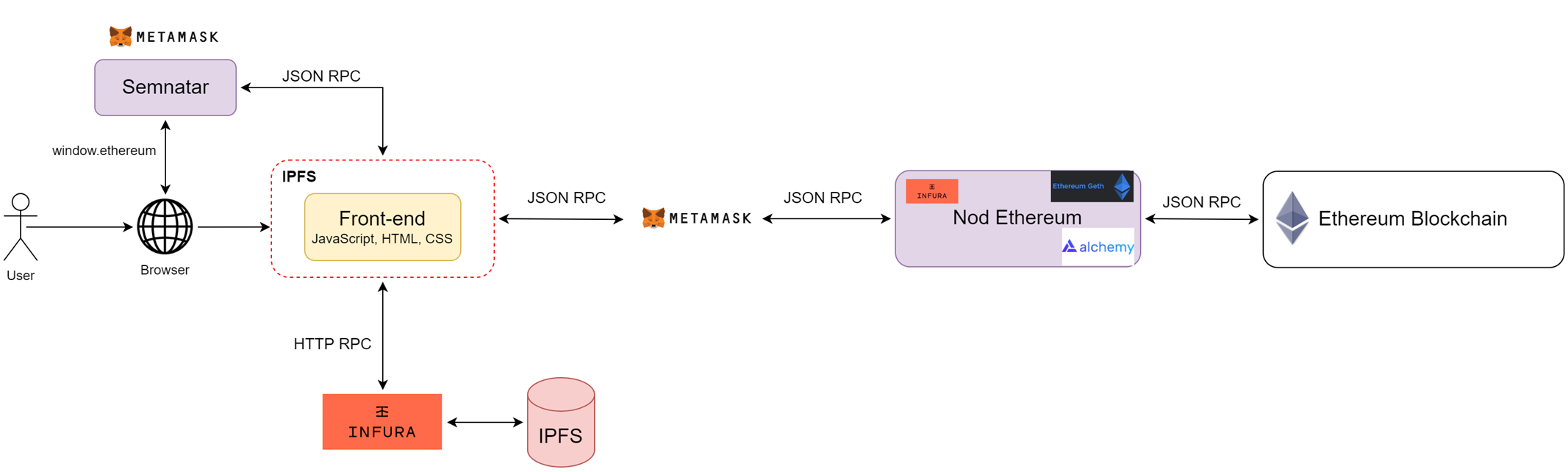
The solution runs on local blockchain (Ganache) and local IPFS node. http://127.0.0.1:8080/ipfs/QmNUioja47pJCbfx1VaJZp917on5JGGaeFPxTGx9bTbCLp/