Time series forecasting for Ruby, ported from Prophet
Supports:
- Multiple seasonalities
- Linear and non-linear growth
- Holidays and special events
And gracefully handles missing data

Add this line to your application’s Gemfile:
gem "prophet-rb"Get future predictions for a time series
series = {
  Date.parse("2020-01-01") => 100,
  Date.parse("2020-01-02") => 150,
  Date.parse("2020-01-03") => 136,
  # ...
}

Prophet.forecast(series)
Specify the number of predictions to return
Prophet.forecast(series, count: 3)Works great with Groupdate
series = User.group_by_day(:created_at).count
Prophet.forecast(series)
And supports advanced API options
Prophet.forecast(series, growth: "logistic", weekly_seasonality: false)Detect anomalies in a time series
Prophet.anomalies(series)Specify the width of uncertainty intervals (decrease for more anomalies)
Prophet.anomalies(series, interval_width: 0.99)Also supports advanced API options
Prophet.anomalies(series, growth: "logistic", weekly_seasonality: false)Check out the Prophet documentation for a great explanation of all of the features. The advanced API follows the Python API and supports the same features. It uses Rover for data frames.
- Quick Start
- Plots
- Saturating Forecasts
- Trend Changepoints
- Holidays and Special Events
- Multiplicative Seasonality
- Uncertainty Intervals
- Outliers
- Non-Daily Data
- Diagnostics
- Additional Topics
Create a data frame with ds and y columns - here’s an example you can use
df = Rover.read_csv("example_wp_log_peyton_manning.csv")
df.head| ds | y |
|---|---|
| 2007-12-10 | 9.59076113 |
| 2007-12-11 | 8.51959031 |
| 2007-12-12 | 8.18367658 |
| 2007-12-13 | 8.07246736 |
| 2007-12-14 | 7.89357207 |
Fit a model
m = Prophet.new
m.fit(df)
Make a data frame with a ds column for future predictions
future = m.make_future_dataframe(periods: 365)
future.tail| ds |
|---|
| 2017-01-15 |
| 2017-01-16 |
| 2017-01-17 |
| 2017-01-18 |
| 2017-01-19 |
Make predictions
forecast = m.predict(future)
forecast[["ds", "yhat", "yhat_lower", "yhat_upper"]].tail| ds | yhat | yhat_lower | yhat_upper |
|---|---|---|---|
| 2017-01-15 | 8.21192840 | 7.52526442 | 8.92389960 |
| 2017-01-16 | 8.53696359 | 7.79124970 | 9.22620028 |
| 2017-01-17 | 8.32439891 | 7.62482699 | 9.04719328 |
| 2017-01-18 | 8.15702395 | 7.40079968 | 8.91301650 |
| 2017-01-19 | 8.16900433 | 7.45673678 | 8.83486188 |
For plots, install the matplotlib gem.
Plot the forecast
m.plot(forecast).savefig("forecast.png")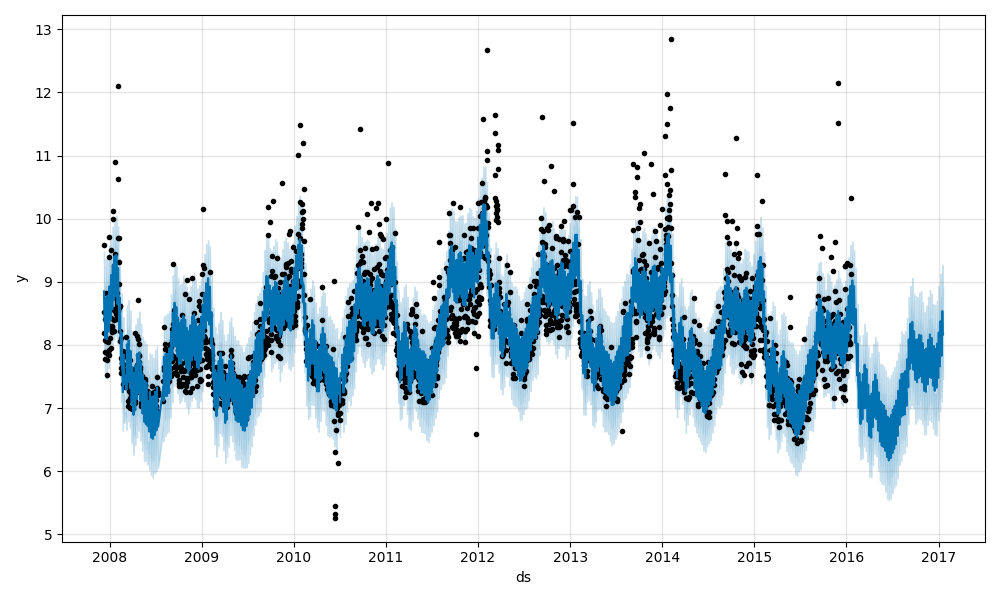
Plot components
m.plot_components(forecast).savefig("components.png")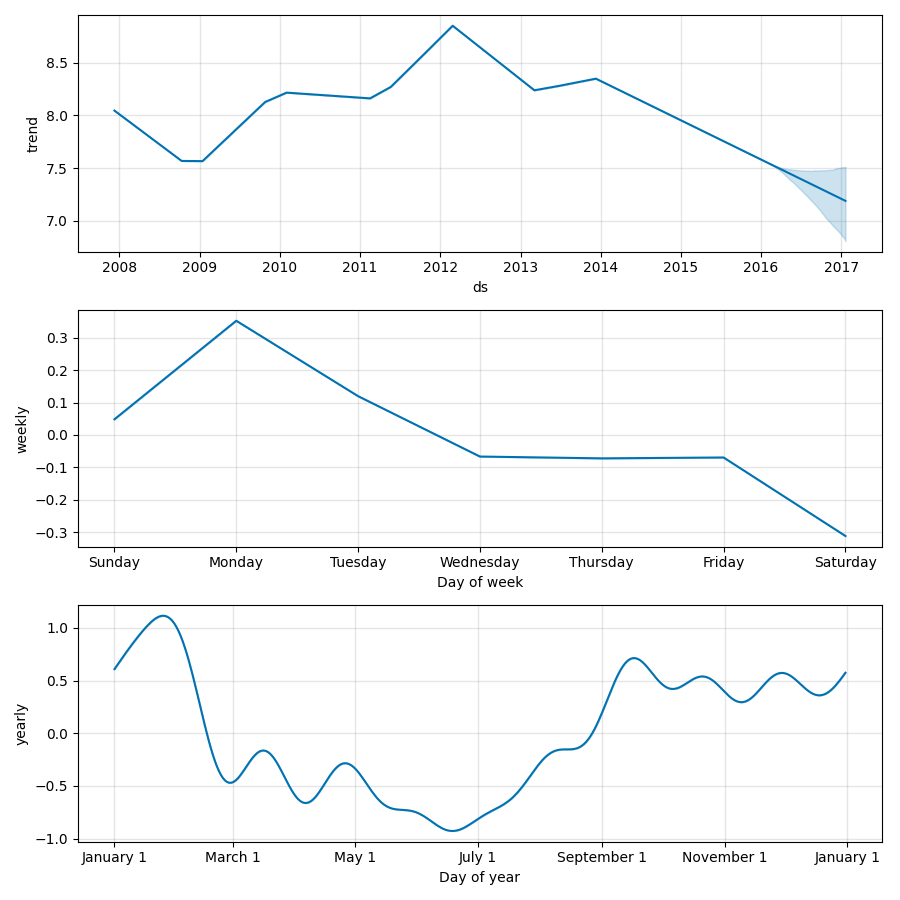
Forecast logistic growth instead of linear
df = Rover.read_csv("example_wp_log_R.csv")
df["cap"] = 8.5
m = Prophet.new(growth: "logistic")
m.fit(df)
future = m.make_future_dataframe(periods: 1826)
future["cap"] = 8.5
forecast = m.predict(future)
Saturating minimum
df["y"] = 10 - df["y"]
df["cap"] = 6
df["floor"] = 1.5
future["cap"] = 6
future["floor"] = 1.5
m = Prophet.new(growth: "logistic")
m.fit(df)
forecast = m.predict(future)Plot changepoints
fig = m.plot(forecast)
m.add_changepoints_to_plot(fig.gca, forecast)
Adjust trend flexibility
m = Prophet.new(changepoint_prior_scale: 0.5)Specify the location of changepoints
m = Prophet.new(changepoints: ["2014-01-01"])Create a data frame with holiday and ds columns. Include all occurrences in your past data and future occurrences you’d like to forecast.
playoffs = Rover::DataFrame.new({
  "holiday" => "playoff",
  "ds" => [
    "2008-01-13", "2009-01-03", "2010-01-16",
    "2010-01-24", "2010-02-07", "2011-01-08",
    "2013-01-12", "2014-01-12", "2014-01-19",
    "2014-02-02", "2015-01-11", "2016-01-17",
    "2016-01-24", "2016-02-07"
  ],
  "lower_window" => 0,
  "upper_window" => 1
})
superbowls = Rover::DataFrame.new({
  "holiday" => "superbowl",
  "ds" => ["2010-02-07", "2014-02-02", "2016-02-07"],
  "lower_window" => 0,
  "upper_window" => 1
})
holidays = playoffs.concat(superbowls)

m = Prophet.new(holidays: holidays)
m.fit(df)
Add country-specific holidays
m = Prophet.new
m.add_country_holidays("US")
m.fit(df)
Specify custom seasonalities
m = Prophet.new(weekly_seasonality: false)
m.add_seasonality(name: "monthly", period: 30.5, fourier_order: 5)
forecast = m.fit(df).predict(future)
Specify additional regressors
nfl_sunday = lambda do |ds|
  date = ds.respond_to?(:to_date) ? ds.to_date : Date.parse(ds)
  date.wday == 0 && (date.month > 8 || date.month < 2) ? 1 : 0
end

df["nfl_sunday"] = df["ds"].map(&nfl_sunday)

m = Prophet.new
m.add_regressor("nfl_sunday")
m.fit(df)

future["nfl_sunday"] = future["ds"].map(&nfl_sunday)

forecast = m.predict(future)Specify multiplicative seasonality
df = Rover.read_csv("example_air_passengers.csv")
m = Prophet.new(seasonality_mode: "multiplicative")
m.fit(df)
future = m.make_future_dataframe(periods: 50, freq: "MS")
forecast = m.predict(future)
Specify mode when adding seasonality and regressors
m = Prophet.new(seasonality_mode: "multiplicative")
m.add_seasonality(name: "quarterly", period: 91.25, fourier_order: 8, mode: "additive")
m.add_regressor("regressor", mode: "additive")Specify the width of uncertainty intervals (80% by default)
Prophet.new(interval_width: 0.95)Get uncertainty in seasonality
Prophet.new(mcmc_samples: 300)Remove outliers
df = Rover.read_csv("example_wp_log_R_outliers1.csv")
df["y"][(df["ds"] > "2010-01-01") & (df["ds"] < "2011-01-01")] = Float::NAN
m = Prophet.new.fit(df)Sub-daily data
df = Rover.read_csv("example_yosemite_temps.csv")
m = Prophet.new(changepoint_prior_scale: 0.01).fit(df)
future = m.make_future_dataframe(periods: 300, freq: "H")
forecast = m.predict(future)Cross validation
df_cv = Prophet::Diagnostics.cross_validation(m, initial: "730 days", period: "180 days", horizon: "365 days")Custom cutoffs
cutoffs = ["2013-02-15", "2013-08-15", "2014-02-15"].map { |v| Time.parse("#{v} 00:00:00 UTC") }
df_cv2 = Prophet::Diagnostics.cross_validation(m, cutoffs: cutoffs, horizon: "365 days")
Get performance metrics
df_p = Prophet::Diagnostics.performance_metrics(df_cv)Plot cross validation metrics
Prophet::Plot.plot_cross_validation_metric(df_cv, metric: "mape")Hyperparameter tuning
param_grid = {
  changepoint_prior_scale: [0.001, 0.01, 0.1, 0.5],
  seasonality_prior_scale: [0.01, 0.1, 1.0, 10.0]
}

# Generate all combinations of parameters
all_params = param_grid.values[0].product(*param_grid.values[1..-1]).map { |v| param_grid.keys.zip(v).to_h }
rmses = [] # Store the RMSEs for each params here

# Use cross validation to evaluate all parameters
all_params.each do |params|
  m = Prophet.new(**params).fit(df) # Fit model with given params
  df_cv = Prophet::Diagnostics.cross_validation(m, cutoffs: cutoffs, horizon: "30 days")
  df_p = Prophet::Diagnostics.performance_metrics(df_cv, rolling_window: 1)
  rmses << df_p["rmse"][0]
end

# Find the best parameters
tuning_results = Rover::DataFrame.new(all_params)
tuning_results["rmse"] = rmses
p tuning_resultsSave a model
File.write("model.json", m.to_json)Load a model
m = Prophet.from_json(File.read("model.json"))Uses the same format as Python, so models can be saved and loaded in either language
Flat trend
m = Prophet.new(growth: "flat")Updating fitted models
def stan_init(m)
  res = {}
  ["k", "m", "sigma_obs"].each do |pname|
    res[pname] = m.params[pname][0, true][0]
  end
  ["delta", "beta"].each do |pname|
    res[pname] = m.params[pname][0, true]
  end
  res
end

df = Rover.read_csv("example_wp_log_peyton_manning.csv")
df1 = df[df["ds"] <= "2016-01-19"] # All data except the last day
m1 = Prophet.new.fit(df1) # A model fit to all data except the last day

m2 = Prophet.new.fit(df) # Adding the last day, fitting from scratch
m2 = Prophet.new.fit(df, init: stan_init(m1)) # Adding the last day, warm-starting from m1Prophet now uses Rover instead of Daru. Two changes you may need to make are:
Rover.read_csvinstead ofDaru::DataFrame.from_csvdf[["ds", "yhat"]]instead ofdf["ds", "yhat"]
This library was ported from the Prophet Python library and is available under the same license.
View the changelog
Everyone is encouraged to help improve this project. Here are a few ways you can help:
- Report bugs
- Fix bugs and submit pull requests
- Write, clarify, or fix documentation
- Suggest or add new features
To get started with development:
git clone https://github.com/ankane/prophet-ruby.git
cd prophet-ruby
bundle install
bundle exec rake vendor:all
bundle exec rake test